
13 Best Affiliate Marketing Networks For 2026: The Social-First Guide For Creators And Brands

Looking for the best affiliate marketing networks? You’re in the right place.
Let’s be real for a second. Most people treat affiliate marketing like a 2010 blog sidebar experiment. They slap a banner up, pray to the Google gods, and wonder why their bank account looks like a desert.
Stop. It didn’t work well back then and it definitely doesn’t work now.
If you’re a creator or social media manager, affiliate marketing isn’t passive income. It’s the engine that turns your engagement into an actual business. It’s how you monetize that TikTok or Instagram following without waiting for a measly Creator Fund check.
And if you’re a brand? You’re not just looking for links. You’re looking for partnerships. You want creators who can move the needle, tell a story, and put your product in front of an audience that actually gives a damn.
But here’s the rub: Most affiliate networks are clunky, outdated relics.
To win today, you need a platform that understands social commerce. You need deep-linking that doesn’t break on Instagram, real-time tracking that accounts for “Link in Bio” traffic, and a roster of brands (or creators) that actually fit your vibe.
In this guide, I’m breaking down the heavy hitters. Whether you’re a brand looking to scale your reach or a social media pro looking to monetize your expertise, these are the only networks worth your time.
Let’s go!
Top picks
| Network | Best For… | Notes | Popularity |
| Levanta | Creators promoting physical products & ecommerce brands | Makes it easy for ecommerce brands to tap into influencer partnerships. Creators can apply directly and unlock partnerships with top ecommerce brands. | 90,500+ vetted creators |
| PartnerStack | B2B SaaS & digital tools | Perfect for bloggers and YouTube influencers promoting B2B software. | 100k+ active partners |
| Rekomi | SaaS brands running their own program | Pays your affiliates for you in 130+ countries and handles the tax forms and 1099s. Affiliates keep 100% of their commission. | 13 native billing and store integrations |
1. Levanta
Levanta is the leading affiliate platform for ecommerce brands, with a network of over 90,000+ creators that drive high-quality traffic and sales through performance-based partnerships. And it’s a great fit for creators that want to promote leading ecommerce brands.
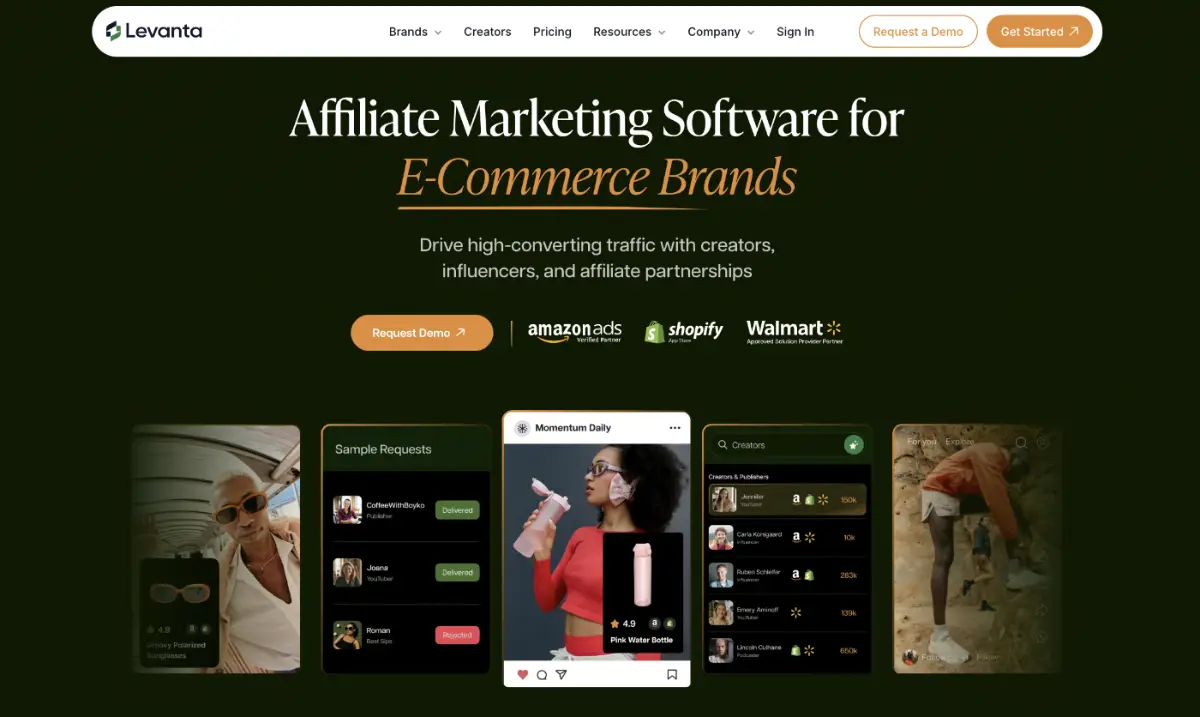
Levanta’s curated network of bloggers & social media creators have a proven track record of generating significant ecommerce sales, and their full suite of affiliate management tools (one-click marketplace integrations, automated affiliate payments, product gifting, social listening, flexible commissioning and more) make scaling your program easy.
Onboarding is straightforward with no hidden fees, allowing brands to quickly tap into Levanta’s leading platform and network.
For creators, Levanta offers a seamless way to partner with top ecommerce brands and earn from authentic product recommendations. And get paid better rates in a lot of cases, too.
Levanta is particularly popular with influencers and social media creators because it handles the admin side, letting you focus on the content that actually generates leads. This includes instant access to brand campaigns, automatic commission tracking, and on-time payments.
The platform simplifies collaboration through instant access to brand campaigns, automatic commission tracking, and on-time payments.
Pros
- Curated network of 90,000+ creators with ecommerce expertise
- Automated product gifting workflows to send creator products for promotion
- Flexible commission structures tailored to brand goals
- Easy onboarding with no hidden fees
- Support for marketplace affiliate programs (ie. Amazon, Walmart and Shopify)
- Best-in-class customer success and support team
Cons
- Does not support B2B, finance, or any non-ecommerce affiliate programs
2. PartnerStack
PartnerStack is more than just an affiliate marketing network. It’s an all-in-one partnership platform that’s purpose-built for SaaS businesses.
If you’re an affiliate marketer looking to promote SaaS (software as a service) products like social media marketing tools, marketing platforms, accounting software etc., PartnerStack is a great place to start your search.
Unlike the other affiliate platforms we’ve looked at so far, PartnerStack caters exclusively to these types of businesses. They don’t have as many registered merchants as Awin, but there are still over 200 programs on the network to choose from, and all of them are in the SaaS sector.
Some of the big names you might have heard of include Monday, Keap CRM, Unbounce, and SocialBee. You can browse the marketplace for free and enroll in as many programs as you want. There are no sign-up costs or hidden fees to worry about.
What’s particularly nice is that each niche has plenty of tools to promote. For example, there’s a healthy number of social media tools to promote such as schedulers, analytics tools, etc.
There are some really juicy commissions on offer too. It varies from program to program, but some merchants pay as much as 50% commission or $2,000 dollars per sale you generate. And there’s plenty of SaaS brands offering 12 monthly or lifetime commissions.
I’ve been using PartnerStack for years. Support has been solid when I’ve needed it. The selection of brands to promote is one of the best I’ve found for my niche. And payouts have been flawless. My only issues have been specific to certain brands which is outside of PartnerStack’s control. But even when those issues occur, PartnerStack has stepped in to help me out when I’ve contacted them.
Note: While PartnerStack is great for publishers, it is also ideal for brands in the B2B SaaS space.
Pros
- High commission rates
- Supports flexible commission structures
- Ideal for digital products
Cons
- Not as many registered merchants as other platforms
3. Rekomi
Rekomi is affiliate and referral marketing software for SaaS and ecommerce brands that want to run their own program instead of renting space on a network.
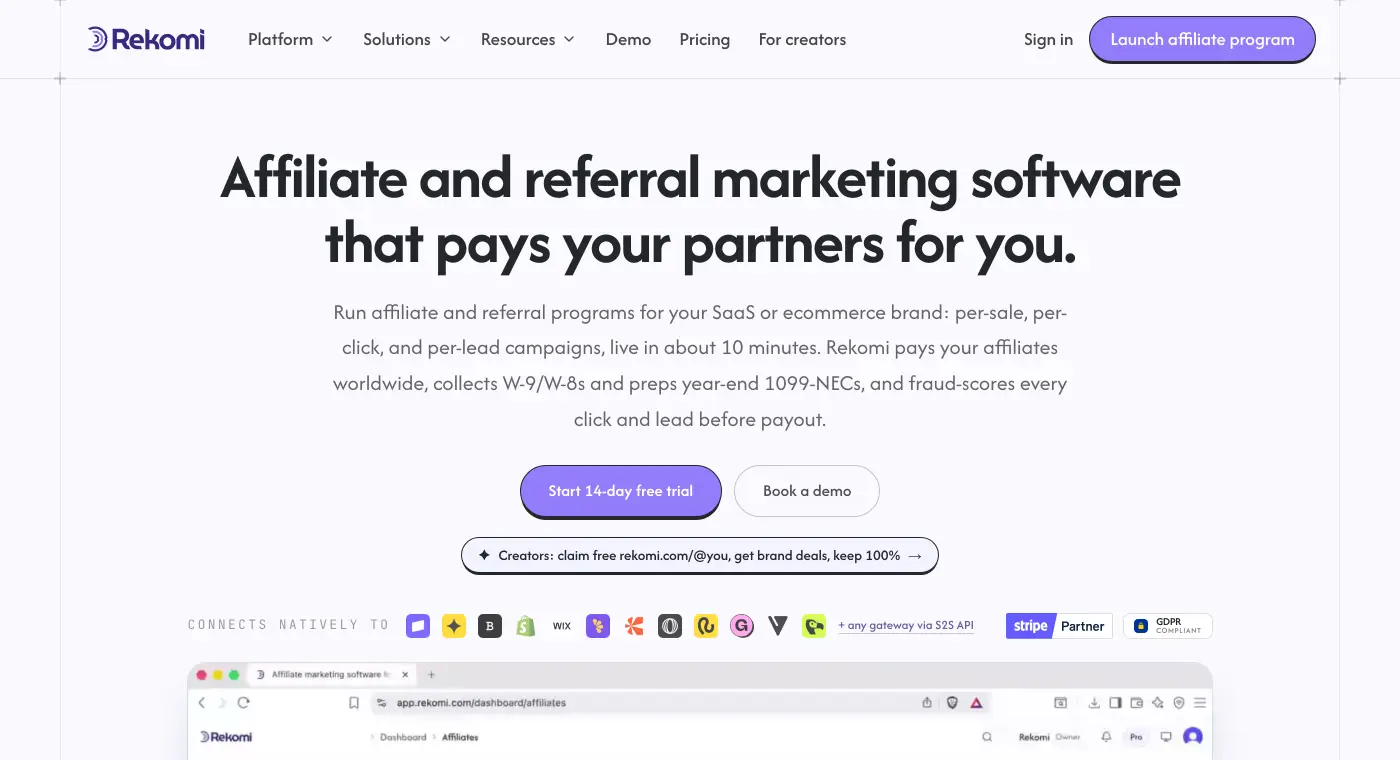
Rekomi is what a brand plugs into its billing or store to recruit, track and pay its own affiliates, and creators join through the brand’s own signup page.
Setup is where it wins. It connects natively to Stripe, Paddle, Braintree, Mollie, Shopify, Wix, Lemon Squeezy, Chargebee, Polar, Recurly, Gumroad, Creem and Dodo Payments, has a WordPress and WooCommerce plugin, and covers the rest with a server-side API.
It is a verified Stripe partner with an app on the Stripe App Marketplace, so a Stripe brand can manage its program from inside Stripe. A campaign is live in about ten minutes and can pay per sale, per lead, per click or any mix. Coupon codes, a custom domain and two-tier recruiting are on every plan, with importers for 20+ other tools.
The bigger difference is payouts. Most affiliate software tracks commissions and leaves the paying to you. Rekomi pays your affiliates for you, by Stripe, bank deposit or PayPal, in 130+ countries, on a schedule you set or on demand, above a minimum you choose. It collects W-9 and W-8 forms and prepares the year-end 1099-NECs as the payer of record, so you never file for your affiliates.
Fraud handling is built in. Every click and lead is scored with device fingerprinting and IP checks before anything is paid, and suspicious traffic is held for review.
Note: If you are an affiliate rather than a brand, Rekomi has its own referral program. It pays 25% recurring for the life of every brand you refer, with a 60-day cookie. Sign up here.
Pros
- Automatic payouts on your schedule, with tax forms and 1099s handled
- Native integrations with 13 billing and store platforms plus WordPress and WooCommerce
- Per-sale, per-lead and per-click commissions in one campaign
- Custom domain and two-tier recruiting on every plan
Cons
- Newer and smaller than the big networks
- The 3% payout fee sits on top of the subscription
- Affiliate marketplace isn’t available (but it is in the works)
4. Awin
Awin is a popular affiliate marketing platform with over 16,500 merchants and 225,000 affiliates.
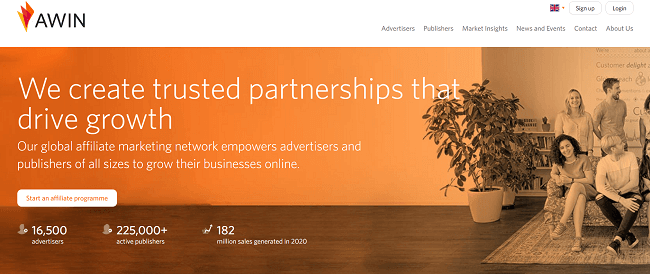
Awin caters more towards a European and global market, with a greater global reach and better multi-language and multi-currency support.
Awin charges affiliates a $5 application fee. This is a bit of a bummer, but it at least gets credited back to your account if/when you’re approved.
Awin gives you access to a wide range of affiliate programs for both physical and digital products, across all verticals. This includes programs by big names like Under Armour, StubHub, Etsy, Gymshark, and AliExpress.
I’d say it’s primarily a better fit for physical products but it now has a decent selection of digital software and services since it merged with ShareASale. That includes brands in the hosting and WordPress space.
Commission rates vary by the merchant but are usually around 5%, and there’s a $20 minimum payout. This can increase dramatically for software-based products.
I’m ranking AWIN so high mainly because it provides one of the most diverse selections of affiliate offers. Not only that but I’ve never had an issue with payouts. Ever.
You’ll have to look past the clunkiness of its UI though. It’s not the easiest to use. And they could definitely improve by offering additional payout methods. But it’s got it where it counts.
Pros
- Greater global reach
- Low minimum payout
- Wide selection of brands
- Large pool of creators and affiliates
Cons
- $5 sign up fee
- Platform UI is VERY clunky
- Restrictive payout methods
5. Amazon Associates
No roundup of the best affiliate marketing networks would be complete without mentioning Amazon Associates. It’s probably the best-known affiliate program on this list and gives you access to literally millions of products.
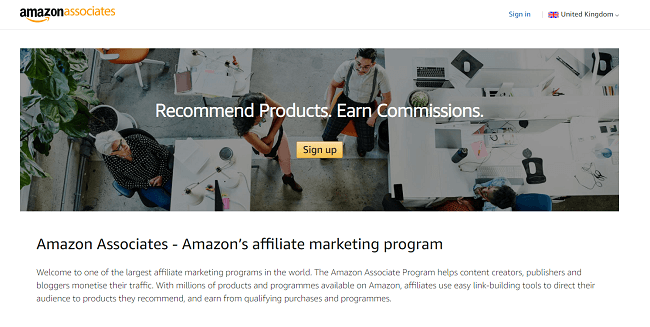
The way Amazon Associates works is that anyone can sign up as an associate and start earning commission on basically anything sold on Amazon (the largest ecommerce store in the world). That includes both Amazon products and products sold by third-party sellers.
Once you’ve signed up for the affiliate marketing program, all you have to do is open up the product page of the item you want to promote, then grab your unique referral link and start using it. Once a customer clicks your referral link, they enter your cookie window and you earn a commission on any product they purchase off Amazon within the next 24 hours (even if it’s not the product you initially linked to).
For example, let’s say you link out to a computer desk and someone clicks through your link and buys it, plus a bunch of other desk accessories. Not only will you earn a commission on the desk, but also on everything else that was in their shopping cart.
Even if they didn’t buy the desk at all, but bought something completely unrelated a few hours later, you’d still get a payout! And given that Amazon is so popular, this happens more often than you might think.
Another great thing about being an affiliate for Amazon is that you get to leverage the platform’s brand recognition. Amazon is a household name, which means your audience is much more likely to trust the platform and feel safe putting in their payment details. This translates to better conversion rates for you.
Sounds pretty good, right? But what’s the catch? Well, Amazon doesn’t offer as attractive commission rates as most of the other platforms in this list. Rates vary depending on the product category and can be as low as 1%.
For example, you can earn up to 7% on purchases in the Home category, but you’ll earn only 1% on things like video games and computers. Amazon has also been known to slash its commission rates from time to time.
The program is also notorious for its strict affiliate policies. After your first few sales, they will review your Associate account to make sure you’re compliant with their Ts and Cs. If everything isn’t in order, they can close your account.
Pros
- Quick and easy sign-up process
- Nearly endless product selection
- High conversion rates (great brand recognition)
- Universal cookie (earn commission on all eligible sales within cookie duration)
Cons
- Very low commission rates
- You must register for the program in each country separately
- Strict terms and conditions
6. Walmart Affiliates
If you’re not happy with Amazon’s commission rates, you might want to check out Walmart’s affiliate program instead.
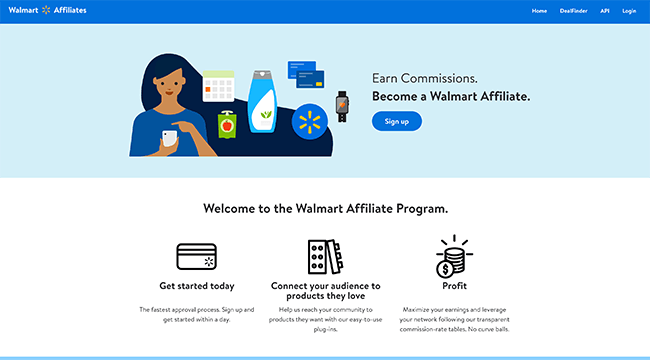
Walmart is a retail giant. It might not hold as great of a share of the online retail market as Amazon, but it commands equally strong brand recognition and has a similarly wide range of products plus an (arguably) more generous commission structure.
Walmart offers greater commissions than Amazon in certain categories, such as toys. If you’re planning on promoting physical products in these categories, Walmart is probably going to be the better option. As an added bonus, Walmart also offers three-day tracking cookies (Amazon’s lasts just 24 hours).
There are tons of physical products to choose from on Walmart but if you’re hoping to promote digital or SaaS products, you’ll need to look elsewhere.
Sign-up is simple and free, and the dashboard is easy to navigate. You can access text links and professionally-designed banners from the weekly newsletter, or generate affiliate links for any product on Walmart in a few clicks.
Pros
- Huge product selection
- Longer cookie duration than Amazon
- High conversion rates
Cons
- Still fairly low commission rates (but better than Amazon in certain categories)
- No digital products
7. Rakuten Advertising
Rakuten Advertising is a well-known affiliate marketing network that caters to the top end of the market. It connects serious publishers with some of the biggest brands around, including household names like Walmart, Best Buy, Wells Fargo, and Virgin Holidays.

It doesn’t offer access to as wide a range of merchants as some of the other networks on this list (though there are still over 1,000 brands on the platform). But what it lacks in quantity, it makes up for in quality because it provides access to some of the biggest mainstream brands.
And whether you’re looking to promote affiliate links across your blog or social media content, a lot of these brands have a similar kind of trust factor to Amazon.
Rakuten has also implemented some innovative features to their platform that make your life as an affiliate easier. These include:
- Discovery tools – Rakuten’s Matchmaking AI provides you with data-driven partnership recommendations so you can find programs that are a good fit for your audience.
- Outstanding support – Regular account reviews from the publisher team deliver useful insights, provide you with ongoing strategy support, and can help connect you to the right advertisers.
- Commissioning Suite – You can take advantage of various commissioning models including dynamic commissioning, coupon commissioning, and multi-touch commissioning
- And more!
Commission rates and cookie durations vary depending on the program you sign up for, and the minimum payout is $50.
Pros
- Trustworthy and reliable
- Lots of high-end brands
- Excellent support and features
Cons
- Not as many merchants as some other platforms
8. CJ Affiliate
CJ Affiliate (formerly known as Commission Junction) is another one of the largest affiliate marketing platforms in the world. It boasts a huge network of hundreds of brands and thousands of publishers, who collectively earn over $1.2 billion every year.
Some of the more recognizable merchants on the platform include Barnes & Noble, IHG, Priceline, Overstock, Office Depot, and more. Affiliate programs are ranked based on their average EPC (Earnings Per Click), so it’s easy to find the best performers.
The initial approval process for CJ affiliate is pretty fast too. It’s free to sign up and you can get on board pretty quickly, but once you’re on the platform, you’ll have to request approval from each merchant you want to promote before you can start earning. You may also lose access to the platform if you don’t make any sales for six months.
Like Rakuten, CJ provides some cutting-edge tools to help with your affiliate marketing efforts, like their innovative Affiliate Personalisation solution, cookieless cross-device journey tracking, detailed analytics, deep-link monetization tools, customizable product widgets, and more.
Those deep-link monetization tools can be quite useful if you’re using a bio link page to promote brands across your social media profiles.
The minimum payout for direct deposits is $50. Commissions and cookie durations depend on the merchant.
Pros
- Useful integrated tools
- Fast initial approval process
- Good range of merchants to choose from
Cons
- The dashboard can be complicated to navigate
9. Partnerize
Partnerize is an innovative new affiliate network marketed as ‘the next generation affiliate platform’.
