
36 Top Lead Generation Statistics For 2026: How Social Media Is Redefining The Funnel

Welcome to my post on the top lead generation statistics you need to know.
Most people think lead generation is a boring game of whitepapers and gated PDFs from 2005.
They’re wrong.
Today, the strongest leads aren’t coming from a cold email blast or a generic Google search. They’re coming from social signals.
Whether it’s a LinkedIn thought-leader building a waitlist or a TikTok creator driving shoppable intent, the gap between scrolling and signing has never been smaller.
If you’re a social media marketer, lead gen is the only metric that keeps your clients paying you. If you’re a brand, your social presence is your primary lead magnet.
In this updated guide, I’ve pulled the most critical lead generation statistics you need to know. You’ll find statistics on social media lead generation, lead nurutring, TikTok lead generation, LinkedIn lead generation, lead generation challenges, and more.
Lead generation at a glance: Key insights
Before we dive into the full list of statistics, let’s look at the big picture of how businesses are finding and converting prospects this year. These insights highlight that while SEO and content marketing provide the foundation, the fastest growth is happening through multi-channel distribution.
| Metric | The Data | Strategic Insight |
| Top Priority | 91% of marketers rate lead generation as their #1 goal. | Revenue growth is the ultimate metric. Every piece of content should have a clear path to conversion. |
| The Quality Gap | 60% of B2B marketers say their biggest challenge is lead quality. | Volume is easy; quality is hard. Use personalization tactics to filter for high-intent prospects early. |
| Social Influence | 44% of businesses believe social media is the best source for high-quality leads. | Social media feeds (e.g. TikTok and Instagram) are now the primary top-of-funnel discovery engine for most social media marketing strategies. |
| Blogging ROI | Companies with blogs generate 67% more leads than those without. | Educational content is still the best way to build the trust needed to drive SEO results. |
| Automation Power | 80% of businesses using automation report generating more leads. | Whether it’s email or chatbot automation, removing manual friction is the key to scaling your ROI. |
| Cost of Acquisition | B2B sales leads cost between $31 and $60 on average. | As costs rise, maximizing the value of every visitor through SMS marketing and nurturing is essential. |
| Content Efficiency | Content marketing generates 3x more leads than outbound methods. | Inbound is more efficient and sustainable than cold outreach, especially when backed by a strong link building strategy. |
General lead generation statistics
We’ll kick things off with a roundup of some general lead generation statistics. These stats show us how important lead generation is to marketers/businesses this year, and reveal some of the most important emerging trends and strategies.
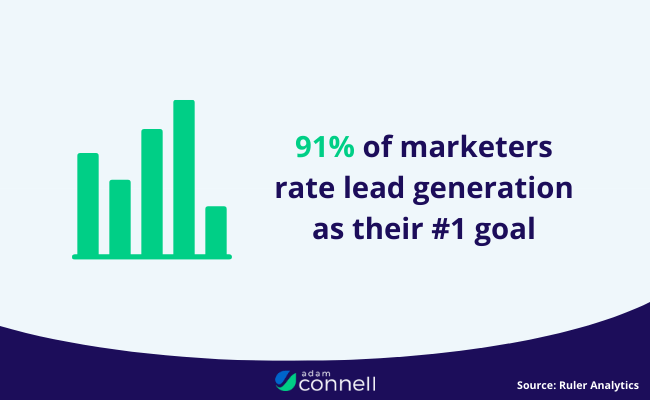
1. 91% of marketers rate lead generation as their #1 goal
For the vast majority of marketers out there, the most important goal is to generate leads. And why wouldn’t it be? After all, leads bring in new business and drive revenue for many businesses. The problem is that with so many marketers out there working towards the same goal, competition for leads is fierce.
Source: Ruler Analytics
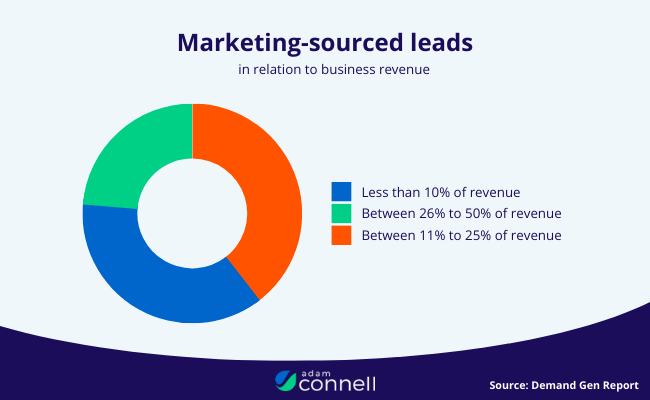
2. 30% of surveyed marketers say marketing-sourced leads account for 11-25% of business revenue.
This is according to a recent report by Demand Gen. In the survey, a further 28% of marketers said marketing-sourced leads accounted for less than 10% of revenue, but 18% said it accounted for as much as 26-50% of revenue. The takeaway: lead generation can have a big impact on your bottom line.
Source: Demand Gen Report2
3. Focusing on lead quality over quantity is a top priority for marketers this year
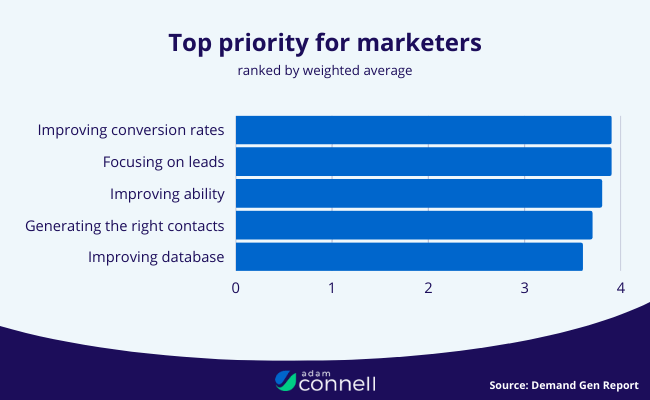
Elsewhere in Demand Gen’s 2023 demand generation, marketers were asked what their top priorities were when it comes to demand generation.
The results showed that focusing on lead quality over lead quantity was the joint top priority for most marketers, the other being improving conversion rates. Both came out with a priority score of 3.9/5.
This reflects a notable shift in lead generation practices that’s occurred over the last few years. In the past, the standard was to gather as many leads as possible. But lately, brands have begun to focus their lead generation efforts on generating smaller lead pools of highly-qualified prospects that are more likely to convert.
Source: Demand Gen Report2
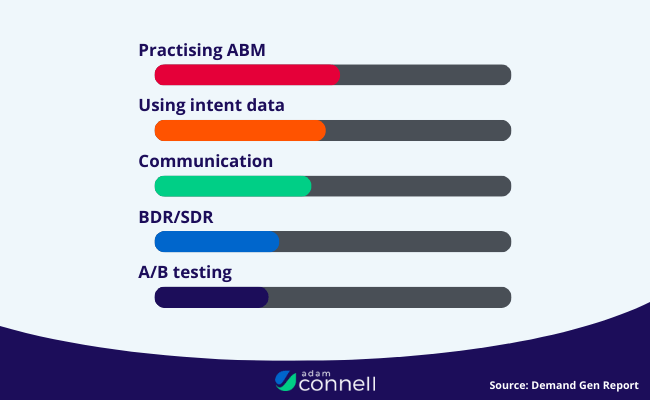
4. 48% of marketers are using intent data to find high-quality leads
As we discussed above, lead quality is a top priority for marketers—but how do they sort the high-quality leads from the poor-quality leads?
Well, to get to the bottom of that question, a recent survey asked marketers how they’re addressing the quality vs quantity challenge of lead generation, and 48% of respondents said that they’re using intent data to better assess prospects who are actively researching a purchase decision.
Source: Demand Gen Report2
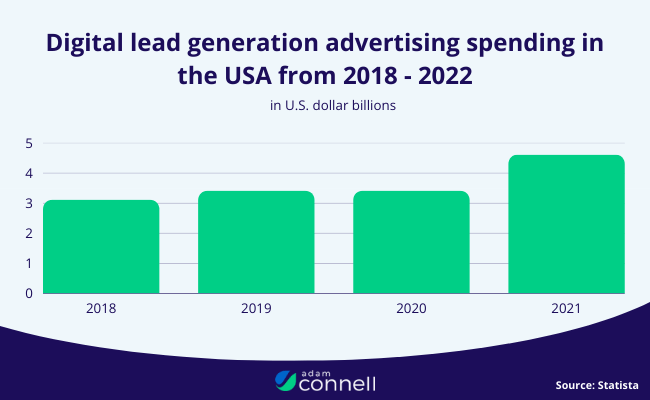
5. Digital advertising spend on lead generation was $4.6 billion USD in 2021
On the surface, that seems to be a mind-boggling amount. But actually, it works out at only around 2% of US digital ad spending, which totaled around $189 billion in the same year.
Source: Statista1
6. 53% of marketers spend over half of their budget on lead generation
Ads aren’t the only cost involved in lead generation. Companies may also devote a good chunk of their budget to other lead-gen efforts like social media marketing, content creation, landing page optimization, etc.
And as this stat shows, all those costs quickly add up. In total, more than half of marketers in a BrightTALK survey reported spending over half of their budget on lead gen. Only 34% spent less than half of their budget on generating leads, and 13% weren’t sure how much they spent.
Source: BrightTALK
7. 49% of companies use marketing automation for lead generation
Thanks to rapid advancements in automation technology, companies are increasingly turning to marketing automation to help with lead generation. 44% of companies now use marketing automation to generate leads (and 55% of B2B companies).
Modern AI-powered SaaS tools enable businesses to put systems and processes in place that collect leads, score them, and even nurture them to conversion automatically. That includes things like email automation software and CRM systems.
In utilizing these tools, businesses no longer have to devote time and resources to manually cold calling and sending out individual emails to get prospects into their sales funnel. Instead, you can run it all on autopilot.
Source: APSIS
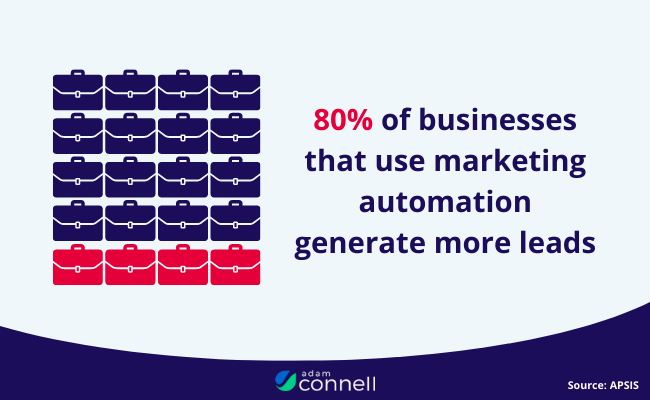
8. 80% of businesses that use marketing automation generate more leads
Marketing automation doesn’t just save you time and money by reducing or eliminating manual processes—it’s also more effective. That’s why 80% of businesses that use automation tools report generating more leads. Not only that, but 77% of them also see more conversions after investing in marketing automation.
Source: APSIS
9. Outsourcing lead generation generates 43% better results
According to one report, trying to handle lead generation in-house might not be the smartest choice. Outsourcing lead generation to experts can improve results by as much as 43%
Source: Jeff Ogden
Lead generation for B2B statistics
Next, let’s take a look at some lead generation statistics that specifically pertain to B2B companies.
10. 40% of B2B marketers say 1-to-1 outreach is the most important factor influencing their success in qualified lead generation
This is according to a recent survey of B2B marketers in the US. A further 37% of respondents in the survey said that speaking to buyer challenges had the biggest impact on their success.
Source: Statista2
11. 31% of B2B marketers think that lead quality is the most important metric
Like the wider industry, focusing on generating high-quality, qualified leads over numbers alone seems to be important to B2B marketers. Around a third of those surveyed said that lead quality is the most important metric that they measure.
Source: APSIS
12. B2B sales leads cost $31 – $60, on average
Oof, that’s a lot. Generating leads clearly isn’t cheap, but if a good chunk of those leads convert to paying customers, it can be worth it.
This average cost data comes from Marketing Insider Group. However, it’s important to note that the report shows that cost varies by industry. Technology industries pay toward the bottom end of the scale per lead, while healthcare businesses pay toward the top end.
Source: Marketing Insider Group
13. 68% of B2B brands use strategic landing pages for lead generation
Using strategic, post-click landing pages that are personalized for each of your target customer segments and marketing channels can improve your traffic-to-lead conversion rates significantly. It’s no wonder, then, that over two-thirds of B2B brands utilize strategic landing pages for lead gen.

Source: Ecommerce Bonsai
14. 56% of B2B marketers verify their leads before they pass them on to sales
Sales teams don’t always get qualified leads from marketing. As this statistic shows, over half the time, they’re getting unqualified leads that haven’t been nurtured enough to close the sale.
Source: Blogging Wizard
Social media for lead generation
Social media is a powerful tool for generating leads and bringing new prospects into your business. Here are some lead generation statistics that reveal more about how social media and lead generation interact.
15. Social media is the best channel for generating high-quality leads
According to Hubspot’s latest State of Inbound Marketing report, social media was rated the most effective channel for acquiring high-quality leads last year. It was also the top marketing channel overall, according to 44% of surveyed businesses.
Source: Hubspot
16. 67% of marketers planned to increase their investment in TikTok for lead generation last year.
Over the last few years, TikTok has gone from a new, niche platform to one of the most popular social media networks in the world, with over a billion users. Marketers have been quick to jump on the TikTok bandwagon and use it as a lead generation channel, with 67% planning to increase spending on TikTok last year.
Source: Demand Gen Report1
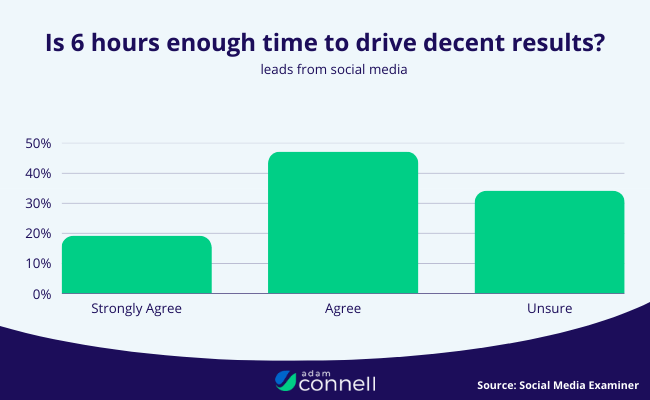
17. 66% of marketers say 6 hours per week is enough to generate good leads from social media
That’s right, you don’t necessarily have to devote that much time to generate high-quality leads from social. 19% of marketers strongly agree and 47% agree that 6 hours is enough to drive decent results. Only 34% said that they weren’t sure or disagreed with that statement.
You can further reduce the time needed to generate leads on social media by utilizing automation tools like social media schedulers to streamline your efforts.
Source: Social Media Examiner
18. LinkedIn accounts for 80% of B2B leads
Unsurprisingly, LinkedIn dominates the social landscape when it comes to generating leads for B2B businesses. The professional social network is the best place to connect with company decision-makers and accounts for 80% of all B2B leads
Source: Oktopost
19. 82% of social media leads come from Twitter
LinkedIn might lead the way in the B2B space, but Twitter is responsible for 82% of the total leads that marketers generate more generally.

Source: Ecommerce Bonsai
Content marketing for lead generation
Content marketing/SEO continues to be another important marketing channel for lead generation. The stats below reveal how businesses are using content to find new leads and nurture them this year.
20. Content marketing generates 3x more leads than outbound marketing
As this statistic shows, content marketing is great for generating leads. It’s not only 300% more effective than outbound marketing tactics, but it also costs 62% less. So you can get more prospects into your funnel while retaining more of your budget.
Source: Demand Metric
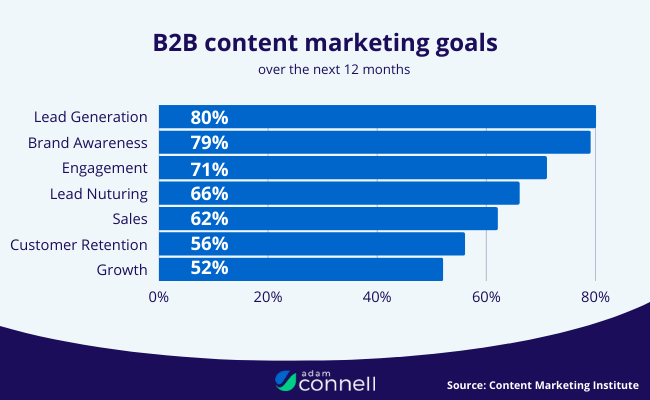
21. 80% of B2B marketers say lead generation is their top content marketing goal
Four-fifths of marketers serving B2B businesses say that the number one goal of their content marketing efforts is to generate leads, according to data from the Content Marketing Institute.
Source: Content Marketing Institute
22. Companies that have a blog generate 67% more leads.
There are lots of different types of content out there that businesses use to generate leads, but blog posts are one of the most effective types. Starting a company blog boosts business leads by 67% on average.
Source: LinkedIn
23. 57% of companies with a blog have generated at least one lead from it
Not all company blogs are successful at driving leads, but most are. The data shows that over half of companies that have a blog have successfully used it to generate leads.
Source: LinkedIn
24. Publishing 15 blog posts a month leads to 1,200 new leads, on average
The pattern seems to be that the more high-quality content you create, the more leads you get. Companies that publish 15 blog posts every month get 1,200 more leads than those that don’t. That works out at around 80 leads per post, on average.
Source: LinkedIn
25. Companies with over 200 published blog posts generate 5x as many leads as those with under 10
Again, this shows that the more effort companies devote to producing content, the more leads they generate.
Source: LinkedIn
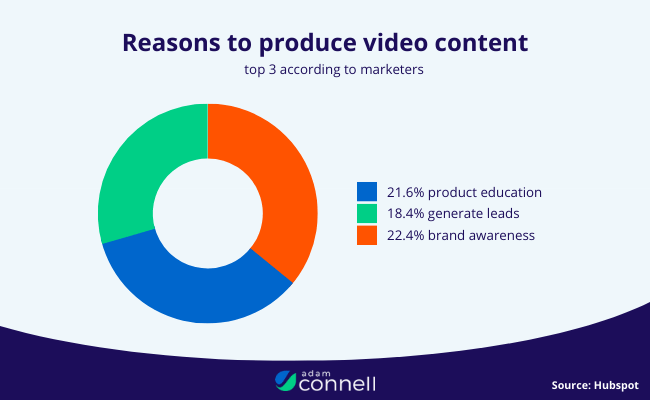
26. 18.4% of marketers say generating leads is their main goal with video content
Written content like blog posts isn’t the only type of content that marketers can use to drive leads—video is becoming increasingly important.
18.4% of marketers say the main reason they produce videos is to generate leads. This makes lead generation one of the top use cases for video content in marketing. It sits just below driving brand awareness (22.4%) and product education (21.6%)
Source: Hubspot
Lead nurturing and conversion statistics
Just getting leads into your funnel isn’t enough. Once you’ve generated leads, you still have to nurture them if you want to turn them into paying customers. Here are a few statistics that tell us more about lead nurturing.
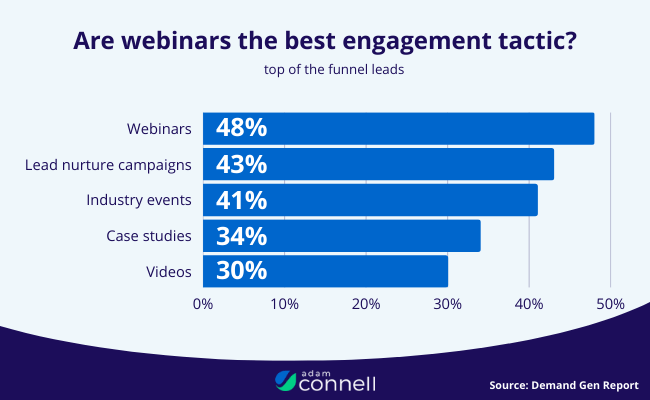
27. 48% of marketers think webinars are the best engagement tactic for top-of-the-funnel leads
Lead generation gets prospects into your funnel, but how do you engage with them from there? Well according to one survey, 48% of marketers think webinars are the way to go, making this the top engagement tactic for top-of-the-funnel leads. Lead nurture campaigns came in second place at 43%.
Source: Demand Gen Report2
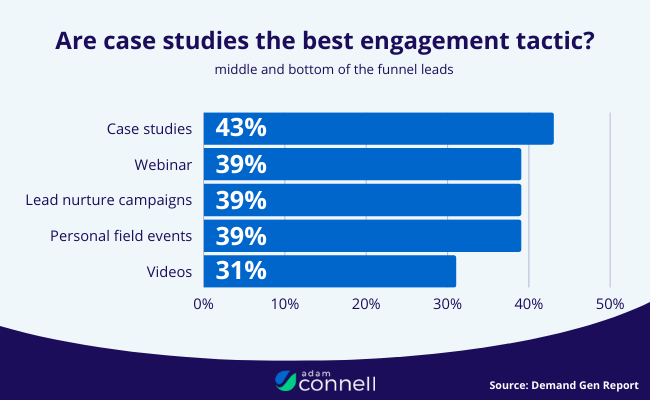
28. 43% of marketers think case studies are the best engagement tactic for middle- and bottom-of-the-funnel leads.
When leads are well-nurtured and have been ushered further down your funnel so that they’re almost ready to convert, case studies are the best way to engage with them, according to 43% of marketers.
Other engagement tactics that marketers think work well for these highly-qualified, bottom-of-the-funnel leads include webinars (39%), lead nurture campaigns (39%), personal field events (39%), and videos (31%).
Source: Demand Gen Report2
29. 65% of b2b businesses don’t have a clear lead nurturing process
Despite the fact that lead nurturing is so important, almost two-thirds of surveyed B2B businesses say they don’t have a defined lead nurturing process in place.
Source: MarketingSherpa
30. Following up with online leads in <5 minutes increases conversions by 900%
Speed is of the essence if you want to convert more of your leads to paying customers. According to the data, leads are 9x more likely to convert when businesses follow up within 5 minutes.

Source: Ecommerce Bonsai
Lead generation challenges
Finally, let’s take a look at some of the biggest challenges marketers face when it comes to lead generation.
31. 63% of marketers rank lead generation as their number one marketing challenge
Lead generation isn’t easy. According to almost two-thirds of surveyed respondents, it’s actually the number one challenge that marketers face.
Source: Demand Gen Report1
32. Only 18% of marketers think outbound lead generation practices provide high-quality leads
Cold calling and emailing clearly don’t work like they used to, as the vast majority of marketers think they fail to provide valuable leads.
Source: Hubspot
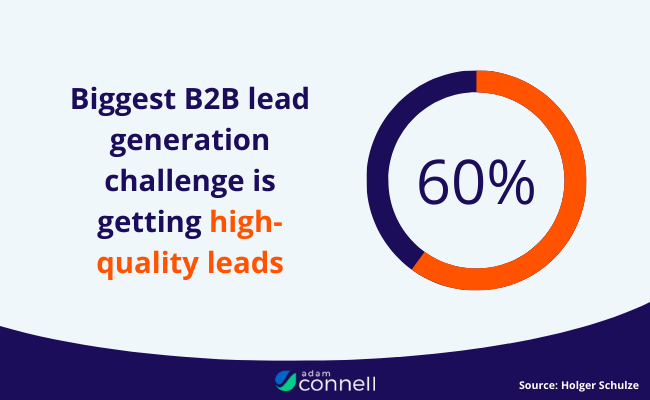
33. Around 60% of marketers think the biggest B2B lead generation challenge is getting high-quality leads
Generating leads is one thing, but generating high-quality leads is a whole other ball game. 60% of B2B marketers think it’s the top challenge. Other big challenges in B2B lead generation include converting leads to customers, creating meaningful lead generation content, and demonstrating ROI.
Source: Holger Schulze
34. Around a quarter of marketers struggle to calculate conversion rates
If you can’t calculate your conversion rates, it’s more difficult to assess the performance of your lead generation campaigns.
Source: Holger Schulze
35. The biggest barrier to B2B lead generation success is a lack of resources
Resources, in this context, refer to staffing, budget, and time. A lack of resources was the top barrier reported in a survey of B2B marketers and was mentioned by over 46% of respondents. Other barriers include a lack of high-quality data and a limited ability to develop content.
Source: Holger Schulze
36. Only 21% of leads convert to sales
No matter how qualified your leads are, a good chunk of them won’t go anywhere. On average, only around a fifth will eventually convert to sales.
Source: MarketingSherpa
Social media lead gen: turning engagement into revenue
While the statistics show that traditional methods like blogging and email are still effective, the way users enter the funnel has shifted. Today, social media platforms are no longer just for brand awareness. They are high-converting lead generation machines.
A successful social media marketing strategy now bridges the gap between a casual scroll and a qualified lead. By leveraging the discovery power of social search, you can get your most valuable linkable assets and research in front of a targeted audience.
Here is how social media is actually driving the numbers in this post:
- Social proof > SEO: 82% of B2B buyers now use social media to research vendors before ever talking to a sales rep. Social media branding is more important than ever.
- Dark social is growing: A massive chunk of the leads in these stats aren’t tracked by standard analytics. They’re happening in Slack groups, DMs, and Discord.
- Short-form video ROI: Lead conversion rates for brands using educational short-form video (Reels/TikTok) are 3x higher than those using traditional landing pages.
But the challenge with social media is that it can be a time suck to manage. But the technology exists to partially solve this problem.
When you combine this social reach with chatbot automation to handle DMs or personalized landing pages, you create a friction-less path that captures leads right at the moment of peak interest.
Frequently asked questions about lead generation
Generating leads in a crowded digital landscape requires a mix of data, technology, and human touch. Here are the answers to the most common questions about optimizing your lead gen efforts.
Final thoughts: building a sustainable pipeline of leads
The statistics in this guide prove that lead generation isn’t a one and done task. It’s a compounding process.
To win, you have to stop thinking about leads in isolation and start looking at how your social media, content, and SEO work together to build a trusted brand.
But you have to dig deeper into each channel. For example, social media lead generation isn’t the same on every platform. You need a seperate strategy for TikTok, Instagram, and other platforms. Even messaging apps.
And the tools you’ll use across channels may differ. For example, an Instagram automation tool may not support TikTok. So, your personalization efforts may need to be tweaked accordingly.
The important things is that the strategy you use for each channel supports the strategies you’re implementing for other channels.
