
35 Top Personalization Statistics For 2026: Why Social Media Is The Ultimate Testing Ground

Welcome to my roundup of the top personalization statistics.
Most marketers treat personalization like it’s nothing more than a first-name tag in an email subject line.
Give me a break. That’s not personalization; that’s a mail merge from 1998.
Today, personalization is tested in the heat of battle on social media. And it’s what social media algorithms themselves know how to do better than most marketers.
It’s the reason your audience stays glued to their screens for hours. So, if you’re a social media marketer, you know personalization is the difference between a viral hit and a total ghost town.
But the real-world use cases of personalization stretch far beyond social media. And that’s what we’ll explore today.
In this guide, I’m breaking down the most critical personalization statistics you need to know. We’ll be covering consumer expectations, personalization strategy, email personalization, how to use social media as your very own personalization testing ground, and more.
Let’s go!
Personalization at a glance: Key insights
Before we dive into the full list of statistics, let’s look at the big picture of how tailored experiences drive growth.
These insights show that personalization is no longer optional; it is a bare-minimum expectation for a cohesive marketing strategy that spans social media, SEO, email, SMS, and more.
| Metric | The Data | Strategic Insight |
| Consumer Expectation | 71% of consumers expect companies to deliver personalized interactions. | If your message feels like a generic blast, the majority of your audience will tune out immediately. |
| Revenue Growth | Companies that excel at personalization generate 40% more revenue. | Relevance is the ultimate multiplier. Tailored offers convert significantly higher than one-size-fits-all campaigns. |
| Customer Loyalty | 78% of consumers say personalized content makes them more likely to repurchase. | Retention is cheaper than acquisition. Use SMS marketing to keep your most loyal customers in the loop. |
| Frustration Factor | 76% of consumers get frustrated when they don’t find personalized experiences. | Friction kills conversions. Use chatbot automation to provide instant, relevant answers to user queries. |
| Social Influence | Personalized social ads have an 80% higher click-through rate than generic ones. | Algorithms favor relevance. Your social media strategy must be built on deep audience segmentation. |
| Lead Quality | 90% of marketers say personalization significantly contributes to business profitability. | High-quality lead generation depends on speaking to a specific pain point at the right time. |
| Content Performance | Personalized call-to-actions (CTAs) perform 202% better than basic ones. | To improve your SEO results, you must guide users toward content that matches their specific stage in the journey. |
General personalization statistics
To kick things off, let’s look at some general personalization statistics that tell us more about the current state of marketing personalization, how often it’s deployed, and the benefits it brings.
1. 89% of businesses are investing in personalization this year
The vast majority of companies finally seem to be recognizing the value of marketing personalization, with almost 9 in 10 allocating budget spend to it this year. And as we’ll see soon, that money is well spent as investing in personalization can have a big impact on revenue.
Source: ProfitBlitz
2. 90% of marketers say personalization makes businesses more profitable
According to data from Think With Google, 9 in 10 marketers think that utilizing personalization significantly contributes to business profitability.
Source: Think with Google
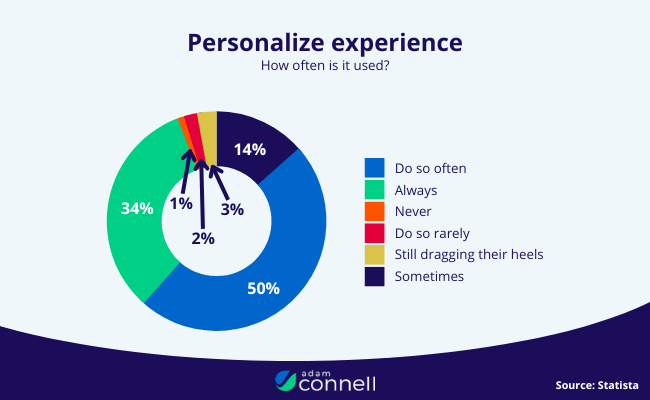
3. 97% of companies personalize experiences at least some of the time
According to a survey of B2C marketers and consumers, 14% of companies personalize experiences sometimes, 50% do so often, and 34% always personalize experiences.
In total, that adds up to a whopping 97. Only 1% of companies never personalize experiences, and only 2% do so rarely. If you’re part of that 3% that’s still dragging their heels when it comes to personalization, now’s the time to catch up.
Source: Statista1
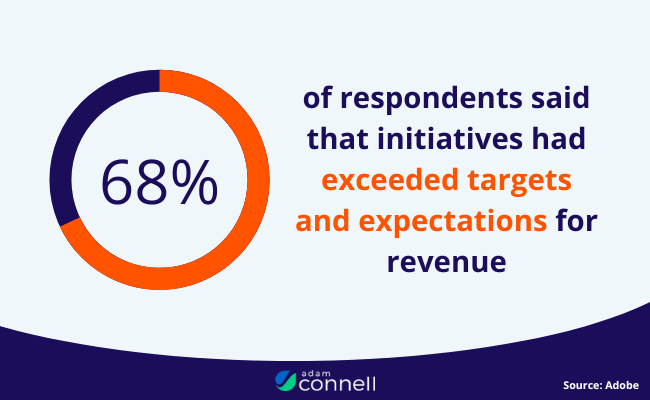
4. 68% of companies say their personalization efforts have exceeded targets
As part of Adobe’s latest personalization report, 1770 global decision-makers were asked about the impact of their personalization initiatives.
68% of respondents said that initiatives had exceeded targets and expectations for revenue. Not only that, but 67% also said they’d exceeded targets and expectations for both customer experience measures and conversion rates.
What does this tell us? Companies and marketers may be underestimating the value of personalization. If the majority are outperforming targets, they may be setting their sights too low.
Source: Adobe
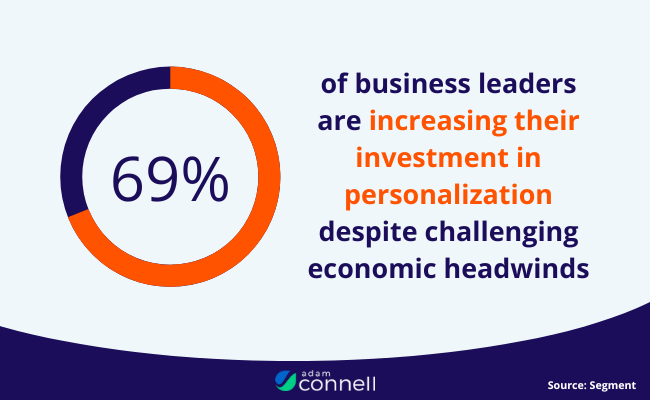
5. Almost 70% of businesses are increasing their personalization spending this year
Not only are more businesses starting to adopt personalization initiatives this year, but those that already have personalization initiatives are increasing spend. Taken together, this paints a clear picture: Personalization is now a hugely important part of marketing that brands can’t afford to ignore.
Source: Segment
6. 55% of marketers think the top benefit of personalization is that it improves visitor engagement and the customer experience
By offering personalized experiences, you can individualize experiences for each customer. For example, by offering content tailored to their preferences, or product recommendations based on their purchase history. This kind of personalization significantly boosts engagement and helps to keep your customers happy. And happy customers are loyal customers.
Source: Evergage
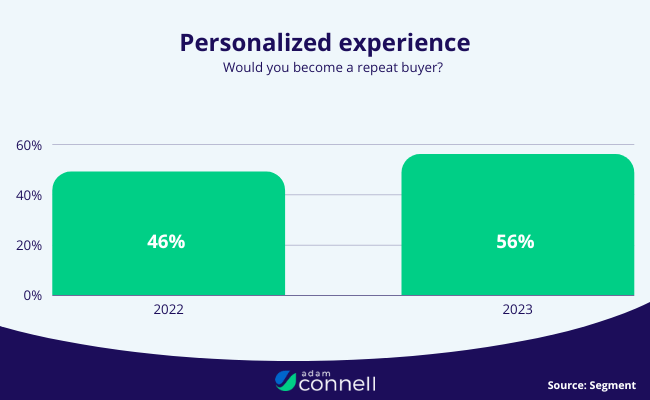
7. 56% of consumers say they will return to businesses if they have a positive personalized experience
That represents a 7% increase year-over-year. The takeaway: Customers that have personalized experiences are more likely to come back again. So if repeat visits and returning customers are important to your business, personalization should be a top priority.
Source: Segment
8. Almost 60% of businesses see an increase in retention and conversions thanks to personalization strategies
Investing in personalization doesn’t just keep your customers happy, it can also have a direct impact on your sales revenue by boosting conversions. In fact, more than half of businesses that deploy personalization strategies see an increase in both conversions and retentions as a result.
One of the most successful and easy-to-deploy personalization strategies for boosting conversions is to roll out personalized product recommendations and upsells.
Source: Blogging Wizard
Personalization & consumer expectations
Next, let’s look at some stats that tell us more about what consumers expect when it comes to personalization.
9. 71% of consumers expect personalization
And 76% of these consumers are frustrated if brands don’t deliver. So if you don’t want to frustrate your consumers, it’s important to start investing in personalization now.
Source: Mckinsey
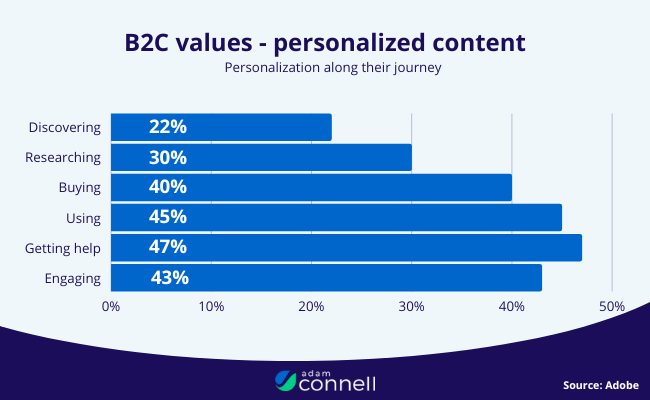
10. 47% of B2C consumers expect fully/mostly personalized content when getting help with a product or service
We know most consumers expect personalization, but their expectations seem to vary across the customer journey.
According to a recent survey, receiving help with a product/service is the stage of the customer journey where most B2C customers expect personalization.
In addition, 45% of B2C consumers expect personalization when using a product/service, 43% expect it when engaging with a company, 40% expect it when buying a product/service, 30% when researching/exploring products and services, and 22% expect it when discovering products and services.
Interestingly, this suggests that personalization is most important to consumers post-purchase, rather than pre-purchase.
Source: Adobe
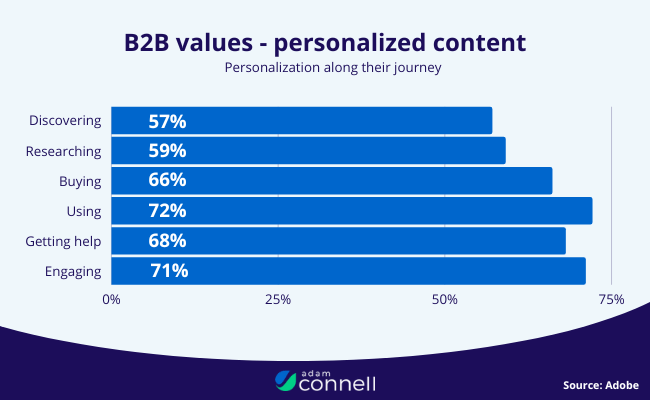
11. 72% of B2B customers expect fully/mostly personalized content when using products and services
As this stat shows, B2B customers have higher expectations than B2C customers when it comes to personalization.
And that’s not just when using products/services but at every stage of the journey.
68% of B2B customers also expect personalization when getting help with products/services, 66% expect personalization when buying products/services, 59% expect personalization in the research stage, and 57% expect personalization in the discovery stage.
Source: Adobe
12. 75% of consumers say they expect personalization to make it easy for them to navigate in-store and online.
This was the top response when respondents in a survey by Mckinsey were asked what personalization actions they expect from brands.
Other top responses were ‘give me relevant product/service recommendations’ (67%), ‘tailor messaging to my needs’ (66%), ‘offer me targeted promotions’ (65%), and ‘celebrate my’ milestones’ (61%)
Source: Mckinsey
13. 40% of consumers wish brands knew more about their style preferences
When asked what personalization features they wish brands knew more about in a survey in the US, UK, AUS, and NZ, this was the top response. A further 24% said they wished brands knew more about their household needs, which was the second top response. And the third most popular response was the wish for brands to know more about the customer’s economic situation.
This presents an interesting dilemma for brands and marketers. On the one hand, as this stat shows, many consumers seem to want brands to have deeper insights into their preferences and needs.
But on the other hand, we also know that many consumers have concerns about data privacy and don’t like it when brands collect too much personal information on them. Speaking of which…
Source: Statista2
14. 80% of consumers think it’s appropriate for marketers to collect data on their purchase history
This makes it the most ‘acceptable’ form of data collection in consumers’ minds. On the other end of the spectrum, less than half of respondents thought it was ok for marketers to collect information on important life events.
Source: Statista3
Personalization strategy statistics
Now we’ll take a look at some statistics that tell us more about the strategies and tactics marketers are using when it comes to personalization.
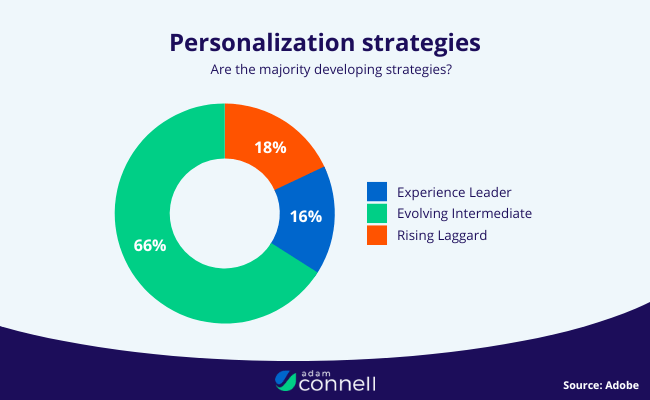
15. 18% of companies have highly mature personalization strategies
Adobe surveyed over 1700 decision-makers from different companies, and sorted them into three groups based on the maturity of their personalization efforts.
16% were classed as ‘experience leaders’. This group was up to 3x more likely to personalize customer journey phases, and 75% of experience leaders had a dedicated personalization COE.
18% were classed as ‘rising laggards’. This group had the least mature personalization strategies.
And the other 66% were classed as ‘evolving intermediates’. This was by far the largest group and suggests the great majority of companies are in the mid-stages of developing a mature, sophisticated personalization strategy.
Source: Adobe
16. Personalized CTAs convert over 200% better than standard ones
One of the easiest but most effective personalization tactics businesses can use is to swap out their generic call-to-actions (CTAs) for personalized ones. That alone can double conversion rates, which can have a serious impact on your bottom line.
Source: HubSpot
17. 70% of consumers say that understanding buyer intent is important for winning their business
All good personalized marketing strategies are grounded in a solid understanding of who your customers are and what they want. And as this stat shows, you need to have a good understanding of buyer intent in order to deliver personalized experiences that drive sales.
Source: Salesforce
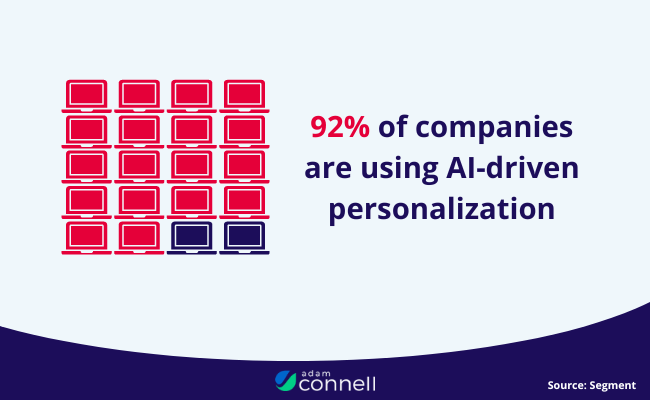
18. 92% of businesses are using AI to power their personalization strategy
Over the past couple of years, AI has surged forward by leaps and bounds. There are now very sophisticated AI SaaS tools out there that you can use to power your personalization strategy and automate experiences at scale.
Source: Segment
Email personalization statistics
Emails are one of the easiest things to personalize and doing so can have a big effect on your conversions and sales. Here are some enlightening statistics relating to the power of email personalization.
20. 70% of millennials find it frustrating to receive irrelevant emails from brands
As we all know, spam from businesses is super frustrating. However, with the help of personalization, businesses can make the most of their email marketing campaigns. Personalizing emails can help businesses to ensure that their millennial customers feel personally targeted, and not frustrated by irrelevant spam
Source: SmarterHQ
21. Emails with personalized subject lines are over 25% more likely to be opened than those without them
If you’re having trouble boosting your email open rates, personalization could be the key. According to Campaign Monitor, emails with a personalized subject line are much more likely to be read than those with generic ones.
Source: Campaign Monitor
22. Personalized emails can increase revenue by 760% according to marketers
And it’s not just open rates that personalization can help with. Marketers also report that personalized email campaigns can increase revenue by as much as 760%.
Source: Campaign Monitor
23. Over half of consumers enjoy receiving targeted discounts and promotions by email
According to Dynamic Yield, consumers don’t just tolerate personalized emails, they actually enjoy it. Over 50% of consumers said that they enjoy receiving discounts and promotions in their inbox, which is why it’s an essential email tactic for ecommerce businesses to try out.
Source: Dynamic Yield
Ecommerce personalization statistics
Personalization can have a significant impact on sales, so if you’re an ecommerce business, then you should be considering personalization as part of your marketing strategy.
Here are some ecommerce-related statistics that highlight the importance of personalization in this industry.
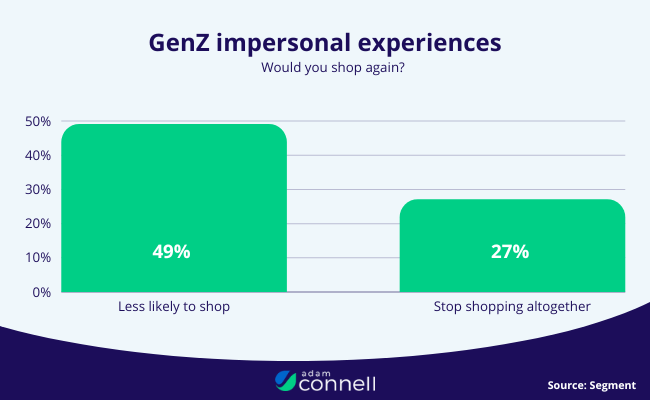
25. 49% of GenZ say they are less likely to shop with a brand that offers an impersonal experience
When it comes to ecommerce, GenZ makes up a big percentage of the target audience for many businesses, and they have some pretty strong opinions about personalization.
Almost half of them said they are less likely to shop with brands that don’t offer a personalized experience, and 27% of them said they would stop shopping with that brand altogether.
Source: Segment
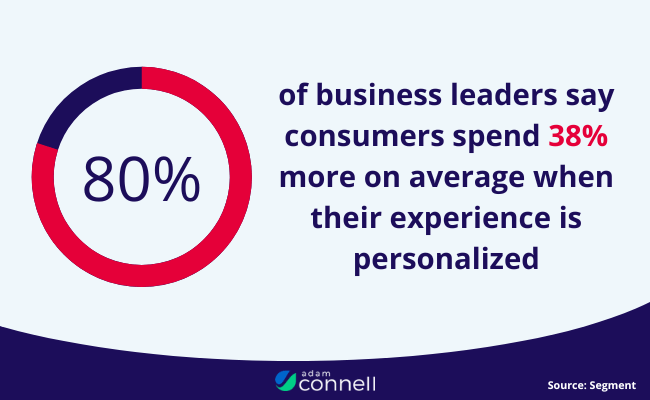
26. Consumers spend 38% more on average when an experience is personalized, according to business leaders
Business leaders put a lot of faith in the power of personalization. According to a Segment report, 80% of the business leaders they surveyed said that consumers spend 38% more when they have a personalized on-site experience.
This is just one of the main reasons why people are so keen to invest in personalization this year.
Source: Segment
27. Over half of frequent online shoppers say they are more likely to visit a site that recommends products
Consumers find online shopping a lot easier if they are recommended products that they might like, or that are linked in some way to other products they have purchased in the past.
Over 50% of consumers said they are more likely to visit a site that recommends products for them.
The reasoning for this is simple: it makes customers’ visits easier, as they don’t have to scroll through tons of products to find what they’re looking for.
Source: Invesp
28. Over half of consumers are willing to share reviews and information about products in exchange for personalized discounts
Reviews and positive feedback from customers are the foundation of a good online business, but gathering this feedback from consumers is not always easy.
However, an article by Retail Touch Points found that more than 50% of consumers will be happy to share reviews and information about products in exchange for personalized discounts.
This is great news for ecommerce brands looking to boost their reputation with the help of consumer feedback
Source: Retail Touch Points
29. 43% of consumers will leave items in their cart in the hope of receiving personalized discounts
Shoppers are getting really savvy, and they’re actually using personalized marketing to get extra discounts from businesses.
According to Blogging Wizard, almost half of consumers will put items in their basket and leave them there, in the hope of receiving personalized email discounts. Pretty smart right?
This is definitely something for marketers to think about when setting up their email marketing automations
Source: Blogging Wizard
30. 76% of consumers said receiving personalized communications makes them more likely to consider purchasing from brands
According to a McKinsey report, consumers respond well to personalized communications from ecommerce businesses.
Over ¾ of respondents said that personalized communications would make them more likely to consider purchasing from brands. This evidences the effectiveness of personalized messaging.
Source: Mckinsey
31. 78% of consumers said personalization made them more likely to repurchase
Personalization can have a big impact on the consumer experience, which is great for building strong customer relationships.
Almost 80% of consumers said personalization would make them likely to repurchase from brands they’ve already shopped with, which shows the importance of post-purchase personalization.
Source: Mckinsey
Personalization challenges
As you can see from the statistics above, there are many benefits to personalization. But to effectively deploy a personalized marketing strategy, there are some challenges to overcome too.
Here are some stats relating to common challenges marketers face when utilizing personalization tactics.
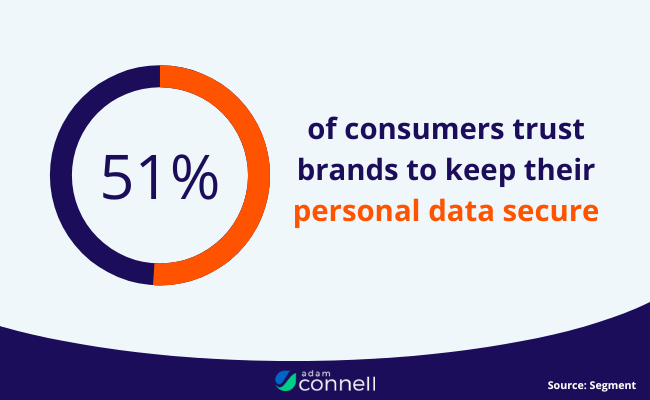
32. Almost 50% of consumers don’t trust brands to handle their data responsibly
One of the biggest challenges for businesses is handling customer data correctly. Data breaches can be bad news for businesses as they are extremely damaging to brand reputation, and can cause customers to be wary of sharing their data.
According to Segment, 43% of consumers do not trust brands to manage their data safely and securely, which causes a big problem for marketers looking to use personalization tactics.
Source: Segment
33. 23% of customers are less comfortable with their data being used than they were a year ago
As well as 43% of customers being distrustful of brands handling their data, the number of people feeling this unease is actually on the rise.
Almost a quarter of customers told Segment that they are less comfortable sharing their data with brands online than they were a year ago, which is a significant roadblock for brands looking to increase their personalization spending.
Source: Segment
34. 41% of consumers find it creepy if they receive a text from a brand as they walk by a store
Although personalization is shown to have a positive impact on consumer spending and conversions, there is a limit to its effectiveness.
According to Ecommerce Bonsai, there are some personalization tactics that consumers find to be creepy or invasive. For example, almost 50% of people get the creeps if they receive a text from a brand as they walk by the store.
Therefore, it’s important for businesses to strike the right balance when using their customer data for personalization.
Source: Ecommerce Bonsai
35. Half of companies struggle to gather accurate data for personalization
In order for your personalization strategy to be effective, it’s essential to gather accurate data about your customers. However, this isn’t always easy. Some consumers are very wary of sharing data and preferences online.
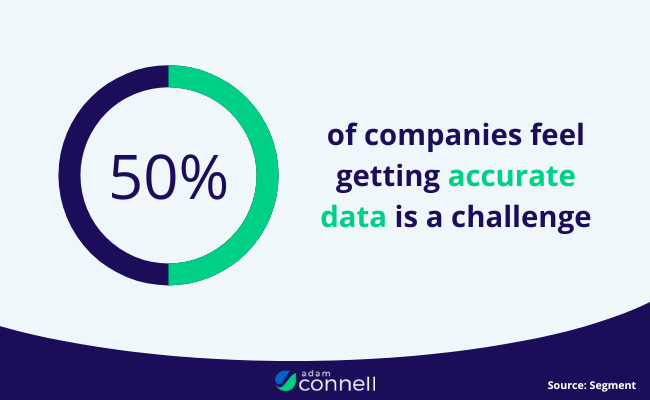
This is becoming increasingly challenging for marketers, and the number of companies claiming that they struggle to gather data has increased by 10 points since last year.
Source: Segment
Social media: the ultimate personalization testing ground
While we often think of personalization in terms of email names or Recommended for You sections on Amazon or how you address someone in an email, the most sophisticated personalization is happening in the social feed. Today, social platforms are the ultimate testing ground for what your audience actually cares about.
Compile all of the data you can. Use social media listening tools and social media analytics tools to squeeze out as many competitive insights as you can.
Then, use this data to inform the rest of your marketing strategy. For example, when you know which topics your audience is responding to best, you can use this to inform your content marketing strategy.
You’ll know which topics to cover on your blog, in email newsletters, lead magnets, and even other content types such as online courses. Knowing these topics will help you prioritise your SEO strategy which in turn, informs your link building efforts.
Make sure every touchpoint feels like it was designed for the individual. This is how you build out your marketing flywheel.
Frequently asked questions about personalization
Implementing personalization can feel overwhelming with so many data points to consider. Here are the answers to the most common questions about making your marketing feel more human.
Final thoughts: the human side of data
The statistics in this guide prove that personalization isn’t just a technical trick; it’s about empathy.
If you want to truly win against your competitors, you have to use your data to become a better resource for your audience. Use it to be more educational, entertaining, or both. Whichever fits best with your business goals.
Whether you’re tailoring your social media strategy, or SMS marketing, the goal is to make the user feel seen and understood. Impersonal marketing is marketing that fails.
Ready to make your marketing more personal?
Start with the data and review your website analytics to see what your audience is actually clicking on.
Then, create content that answers the specific questions your customers are asking. These SEO tools can help.
Next, see how chatbot automation can help you deliver personalized answers at the exact moment of need.
If you want to learn more about other areas of marketing, here are a bunch of other statistics articles worth your time:
