
45 Critical Chatbot Statistics You Need To Know In 2026

Chatbot technology has come a long way over the last few years.
The first iterations of chatbots look nothing like the apps we use today. Back then, they could do little more than process hard-coded words and phrases and deliver basic scripted responses.
Now, next-gen chatbots utilize AI and machine learning to understand user queries. Regardless of how they’re worded. And they are capable of offering personalized, intelligent, conversational support.
But will chatbots be a good fit for your business?
In this post, you’ll find the most relevant chatbot statistics to help you learn more about the benefits of chatbots, how consumers feel about them, and what trends to expect in the coming years.
Chatbot strategy at a glance: key insights
Before we dive into the full list of statistics, this table highlights the most critical data points regarding how businesses and consumers interact with AI today.
These insights show that chatbots are no longer just for support. They are now vital for social media lead generation and personalized marketing.
| Metric | Data | Strategic insight |
| Market growth | The global chatbot market is expected to reach $27.3 billion by 2030. | AI isn’t a fad; it is becoming the primary interface for digital commerce and brand communication. |
| User adoption | 88% of consumers chatted with at least one chatbot in the past year. | Chatbots are now a mainstream expectation. If you aren’t offering automated chat, you’re missing a key touchpoint. |
| Response speed | 59% of users expect a chatbot to reply within 5 seconds. | Speed is the new currency. Chatbots allow you to scale your marketing without scaling your team. And they can be integrated into social media platforms. |
| Sales impact | Business leaders report a 67% average increase in sales via chatbots. | Automation doesn’t just save time; it drives revenue by moving users through the funnel faster. |
| Consumer preference | 62% of users would rather use a bot than wait for a human agent. | Efficiency is more important to consumers than personality. Use bots to handle the FAQ-style queries that slow down your team. |
| Social integration | There are over 300,000 active chatbots on Facebook Messenger alone. | Messaging apps are the new homepage. Integrating bots into your social media strategy is essential for 24/7 engagement. |
| Lead quality | 55% of companies using chatbots report an increase in high-quality leads. | Bots are the ultimate filter. They qualify users in real-time before passing them to your lead generation funnel. |
General chatbot statistics
First, let’s take a look at some key chatbot statistics that tell us more about the current state of the industry and highlight some of the main benefits chatbots offer to businesses.
1. The global chatbot market is expected to be worth $455 million by the end of 2027
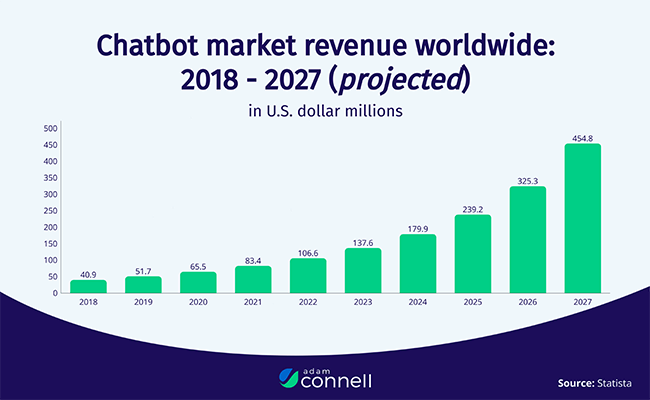
The size of the worldwide chatbot market varies depending on who you ask. Estimates range from $100 million or less to upwards of $5 billion USD.
This projected figure for 2027 ($455 million) from Statista is calculated based on the market value in 2018 and the expected CAGR. The fastest-growing market for chatbots is in East Asia.
Whichever way you look at it, it’s clear that the chatbot market continues to grow rapidly. This growth is mirrored in the SEO industry, where AI is increasingly used to interpret search intent and automate content delivery.
Source: Statista
2. Chatbots are the fastest growing communication channel for brands

According to a recent report, the usage of chatbots as a brand communication channel rose by 92% between 2019 and 2020 alone. In 2019, around 11% of brands communicated with buyers via chatbots but by 2020, that figure was close to 25%.
This shift towards greater adoption of chatbots as a brand communication channel was no doubt driven by the global pandemic.
Call centers that usually took customer service and sales calls all over the world were forced to temporarily close in order to allow employees to self-isolate. That, plus soaring absences and budget cuts forced companies to pivot to alternative ways of communicating with their customers. For many, the answer was chatbots.
Source: Ecommerce Bonsai
3. Chatbots can answer up to 79% of routine questions
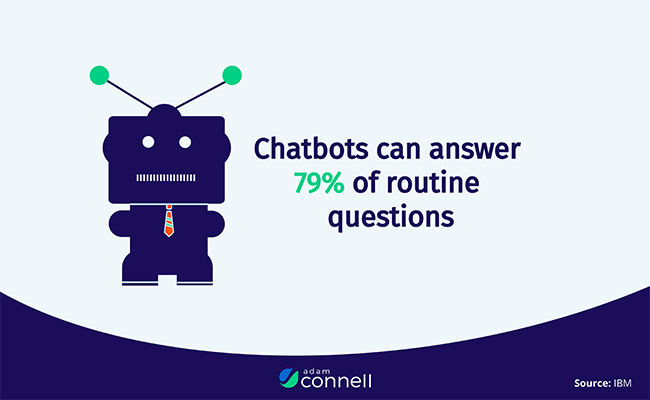
It’s no secret that chatbots have got a lot smarter over the past decade. Once upon a time, they could only field a handful of very common questions. Now, some chatbots are able to answer the vast majority (almost four-fifths) of routine questions.
Some of the most advanced chatbots can even answer non-routine, personalized questions. As chatbot technology continues to get better and better, so too will their ability to effectively answer more user queries.
Source: IBM
4. Businesses save around 30% on customer support costs with the help of chatbots
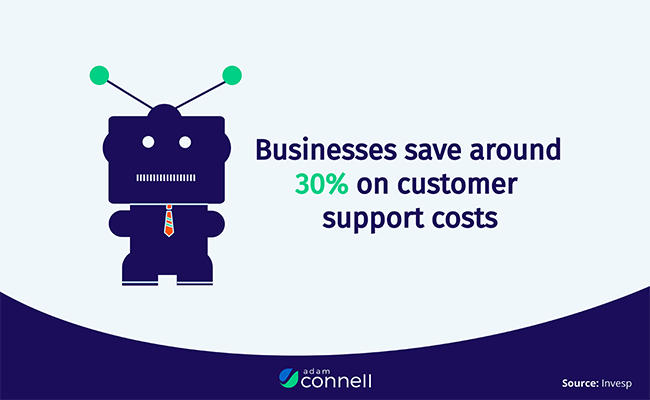
As this stat shows, cost savings are one of the biggest advantages chatbots offer businesses. By utilizing customer support chatbots, you can substantially reduce the number of customer support calls your team needs to take, thus reducing your necessary spend on human resources.
Your chatbot can answer all the routine support queries for you, freeing up your team’s time to focus on more complex queries.
Source: Invesp
5. Chatbots can reduce routine question response times by as much as 80%
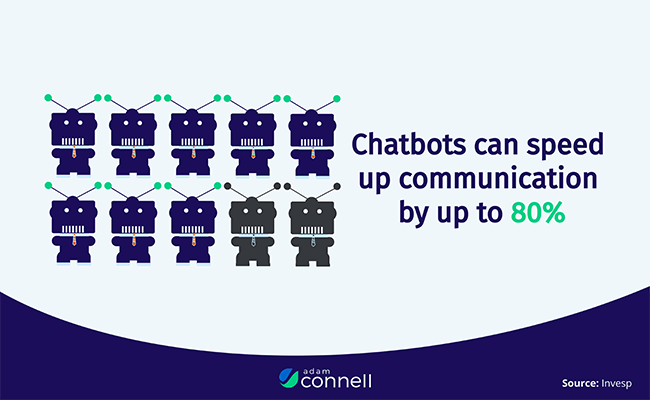
Not only can chatbots answer 80% of routine questions, but they can also answer those questions 80% faster than live agents.
Chatbots provide instantaneous responses to user queries, so customers won’t need to wait around for an agent to get back to them, thus reducing response time significantly. From a customer service perspective, this is a big deal. It can substantially improve the customer experience, help with customer retention, and boost your conversion rates.
Source: Invesp
6. 31% of companies that customized their chatbot messages reached their company goals
Instead of relying on default scripts, brands can customize their chatbot messages so that they ask the right questions and deliver on-brand messaging. Companies that did this reached their goals 31% of the time.
Source: Tidio
Chatbot usage statistics
The chatbot statistics below reveal how many brands and consumers use chatbots and how often they interact with them.
7. Around 67% of consumers have used a chatbot within the last year
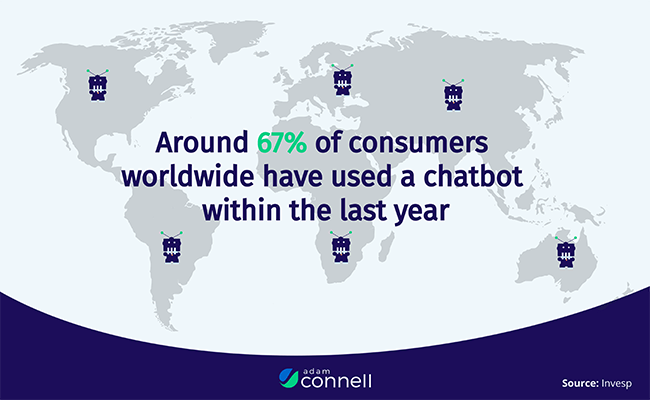
Chatbots are ubiquitous right now. It seems like on every website you visit, you’ll find a chatbot icon in the bottom corner. As a result, it’s not all that surprising that more than two-thirds of all consumers have interacted with a chatbot within the last 12 months.
Websites are not the only place where adoption is increasing. Since most users are active on mobile, integrating bots with your SMS marketing campaigns ensures you never miss a high-intent inquiry.
Source: Invesp
8. 62% of users interact with chatbots a few times per month or less
Despite the fact that the majority of people have used a chatbot, most people don’t interact with them on a daily basis. A little under two-thirds of people use them a few times per month or less.
Source: Solvvy
9. People use chatbots most often between 8 AM and 5 PM
Somewhat surprisingly, more people use chatbots during business hours than outside of them. The most common time of day for people to use chatbots is from 8 AM to 5 PM, when most people are at work.
The exception to this is retail chatbots. Consumers are more likely to use retail chatbots after 5 PM or on the weekends, which makes sense given that this is when most people do their online shopping.
Source: Solvvy
10. Around 80% of users will use chatbots when they’re offered
Most people don’t tend to seek out chatbots, but 80% of internet users will use them when they’re offered. The upshot of this for marketers and bloggers is clear: if you want people to interact with your chatbot, make sure you’re clearly signposting it so that visitors know it’s available.
Some websites go as far as to automatically send messages via chatbot to visitors on the page, asking them if they need help or sending them information. This opens up the chatbox so that they can’t miss it.
Source: Solvvy
11. A third of chatbot users are ‘Power Users’
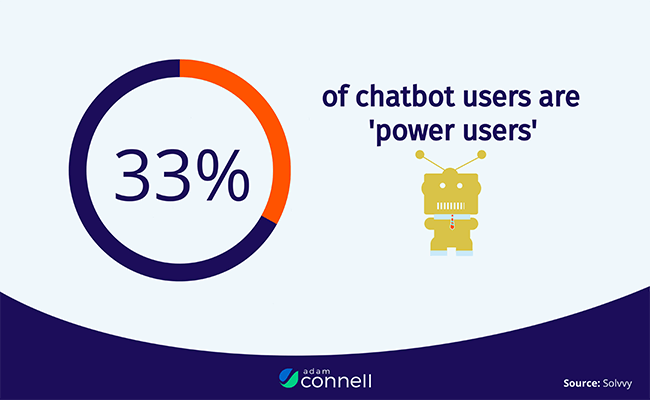
According to a recent study, chatbot users can be broadly categorized into two distinct groups: Standard Users and Power Users.
The main difference between these two segments is that Standard Users use chatbots a few times per month and stick to basic questions, whereas Power Users seek out chatbots for advanced or highly personalized issues like managing subscriptions and initiating orders. Power Users are also more frequent users and tend to return to chatbots weekly or even daily.
Even more Standard Users are expected to become Power Users as chatbot technology becomes increasingly sophisticated.
Source: Solvvy
12. 70% of banking and consumer services users have used the same chatbot repeatedly
People who use chatbots for banking and consumer services are more likely to use it on multiple occasions (70%) compared to retail users (58%). Across all industries, around two-thirds of users have used the same chatbot more than one time.
Source: Solvvy
13. Chatbots handle conversations from start to finish around 70% of the time
Many people believe the misconception that chatbots can’t do much more than greet customers before routing their queries to a live agent.
However, this couldn’t be further from the truth.
According to a recent report, modern chatbots are now able to handle full conversations with consumers over 69% of the time thanks to advancements in AI (Artificial Intelligence) technology. That involves asking follow-up questions and providing answers until the query is fully resolved. Some are even capable of dealing with highly personalized and complex tasks.
Source: Blogging Wizard
Chatbot consumer benefits
Now we know how many people use chatbots, let’s talk about why they use them. Here are some statistics that tell us more about the benefits chatbots offer to consumers.
14. 64% of customers say that 24/7 service is the best part about using a chatbot
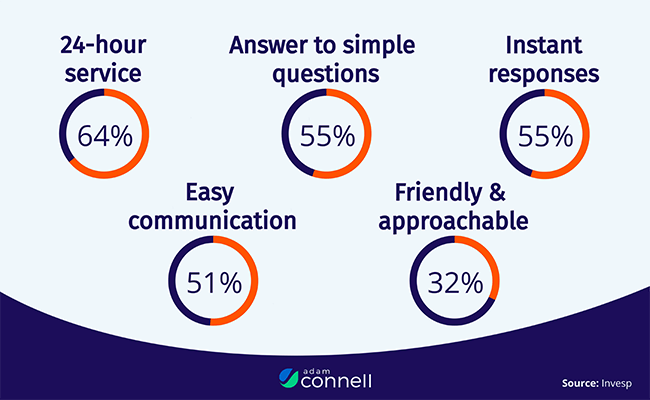
One of the biggest benefits of chatbots is that they’re available 24/7 and can continue to provide customer support and collect leads long after your sales and support reps finish their shifts.
Traditional customer communication channels like telephone, email and live chat are usually limited to standard business hours. However, many consumers need support outside of the usual 9-5 schedule, so it’s not surprising that almost two-thirds say 24/7 service is the biggest benefit to using a chatbot.
Source: Invesp
15. 65% of users want their queries and issues dealt with without any human support
This stat debunks another common misconception about chatbots: the idea that consumers would prefer to speak to live agents than robots. As this statistic shows, this couldn’t be further from the truth.
On the contrary, almost two-thirds of users say they’d prefer to be able to have their issues solved without having to speak to a real human. Chatbots offer these types of users an alternative way to get answers to their queries.
Source: Adweek
16. 55% of people would prefer to use a chatbot than wait for a live agent
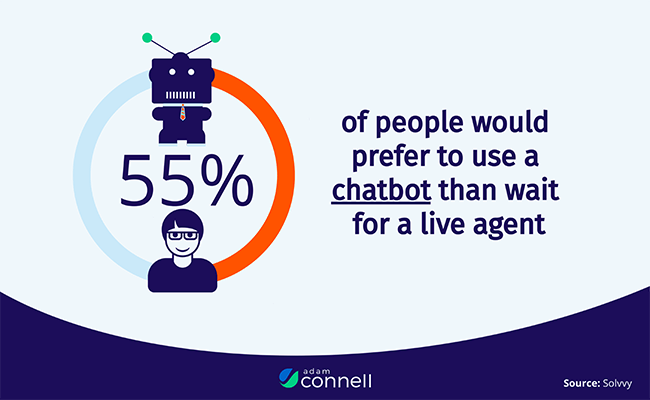
There’s nothing worse than waiting around forever for a live agent to respond to your customer support query. Fortunately, with chatbots, you don’t have to. Chatbots provide instantaneous responses so you can get immediate answers to your question and move on with your day.
It’s no wonder that 55% of consumers say they’d prefer to use a chatbot if it meant they didn’t have to wait for a live agent.
Source: Solvvy
17. 53% of customers give up in the first 10 minutes of waiting for an agent
That’s the average across industries, but in the retail industry, customers are even more impatient. 55% of retail customers give up before the 10-minute mark, and 17% won’t even bother to wait for 5 minutes.
This goes to show just how important it is to offer rapid response times. If you’re taking too long, you’re losing sales. Chatbots offer instant response times and can help to keep customers happy and ensure you don’t needlessly lose sales.
Source: Solvvy
18. 69% of customers would use a chatbot if they knew it could resolve the issue more quickly
If you needed more evidence that customers prefer chatbots for their fast response times, here it is. 69% say they’d use them if it meant they could get a more speedy resolution to their query.
Source: Solvvy
19. 69% of users consider chatbots to be helpful
Chatbots are still not perceived to be as helpful as live agents, but they’re getting there. Over two-thirds of users now find them helpful. This probably wouldn’t have been true a decade ago.
Source: Solvvy
20. Almost half of all chatbot users think they may have mistaken a chatbot for a real person
Modern chatbots are very convincing. So convincing, in fact, that 47% of users think it’s possible that they might have mistaken one for a live customer support agent at some point. A further 11% of chatbot users aren’t sure whether or not they’ve ever mistaken a chatbot for an agent.
Source: Solvvy
21. Chatbots are less likely to cause businesses to lose customers
One interesting phenomenon regarding chatbots is that users tend to react less severely to negative interactions with them when compared to interactions with live agents.
Customers who have a negative experience when speaking to live agents are more likely to stop buying products or services from the company than if they are following a negative experience with a chatbot.
The reason for this isn’t entirely clear, but it’s likely related to human psychology. A negative interaction with another human usually feels more confrontational and emotionally loaded compared to a robot.
Therefore, following these kinds of interactions, consumers are more likely to walk away from the business that they feel is responsible for causing them this level of distress and inconvenience.
Source: Solvvy
22. 40% of consumers don’t care whether their query is dealt with by a human or a chatbot
Despite all the benefits chatbots offer to consumers, many people are still largely indifferent to them. 40% of people don’t mind who deals with their query— human or robot—as long as their issue gets resolved.
Source: Invesp
Chatbot use cases
Next, let’s take a look at some chatbot statistics that reveal some of their main use cases in different business settings.
23. Almost 60% of companies using chatbots do so to improve customer service
Naturally, the biggest use case for chatbots is to provide better customer service. Data from Tidio tells us that 60% of companies use chatbots for this reason.
Despite this, though, many people remain skeptical of the benefits of using chatbots in a customer service setting.
Some of these skeptics think that the most important part of customer service is having an accurate understanding of customer problems and believe that this is something many chatbots still struggle with.
Without an accurate understanding of the issues your customers are having, you can’t offer a resolution to them. Fortunately, chatbots continue to get better and better at understanding complex queries, which is one of the main reasons they’re increasingly being used by customer service organizations.
Source: Tidio
24. 52% of companies use chatbots primarily for welcoming new customers
Over half of companies use their chatbots to send welcome messages to customers.
When you go into a physical store, you’ll often be greeted by a customer service representative. Chatbots can do the same thing when customers visit your online store to create a good first impression and make your business seem more approachable.
But it’s not all about greeting the customer. Your welcome message can also be used to generate leads (for example, it could invite the visitor to leave their contact information in the chatbox), nurture existing leads, and onboard new customers.
Your welcome message is the first point of contact between you and your site visitors and initiates the entire flow of conversation, so it’s important to get it right.
Source: Tidio
25. Chatbots are the third most popular way to resolve customer support issues
Chatbots have shot up the list in recent years and now rank just behind live agent chat and phone calls as the most popular way to resolve customer support issues.
This proves that chatbots aren’t about to take away human agent jobs just yet (and probably for a long time to come) but they can still complement your support strategy.
Source: Solvvy
26. 59% of companies using chatbots want customers to get answers more quickly
Almost two-thirds of businesses that use chatbots do so to provide faster support to their customers. These companies understand the importance of offering rapid responses to consumers and the huge impact this can have on their bottom line.
Source: Tidio
27. 39% of companies use chatbots to help make their site more interactive for users
Another upshot of using chatbots is that it makes your website pages more interactive. Making your site more interactive can reduce your bounce rate, increase dwell time, and drive engagement.
Instead of being limited to browsing your web pages, customers can interact with the chatbot directly to get answers to their specific questions and find the information they’re looking for.
Source: Tidio
28. The top use case for banking and consumer services chatbots is troubleshooting issues and managing accounts
The banking and consumer services sector is one of the biggest adopters of chatbot technology. Unlike other industries, consumers in these sectors frequently require direct customer support.
For example, banking customers may need help to order a new credit card, query unknown transactions, or manage their overdraft limits, all of which are traditionally done by speaking to an agent over the phone or via email.
Chatbots provide a way for companies in these industries to offload some of their simpler customer support requests to automated software and reduce call queues so that their agents can focus on the queries that require direct human support. The top use case for chatbots in these sectors is troubleshooting issues and managing accounts.
Source: Solvvy
29. 58% of companies using chatbots technology are B2B focused
In addition to the B2C space, plenty of B2B companies are utilizing chatbot technology. If you’re running a B2B business, it’s worth considering how they might be able to help boost your bottom line.
Source: Chatbot Magazine
Ecommerce chatbot statistics
Many ecommerce sites use chatbots to increase revenue. Here are some chatbot statistics pertaining to the ecommerce industry.
30. 77% of the most successful lead generation chatbots are used by ecommerce stores
If you’re running an online store, it’s definitely worth looking into chatbots. They can have a huge impact on your business and help you to drive sales, offer better customer service, and improve efficiency.
Just think about it: your chatbot can help sell products even when a member of your sales team isn’t available. This makes it great from a lead generation perspective.
Most popular ecommerce platforms will provide an easy way to integrate chatbots into your store, via a dedicated integration or code snippet.
Source: Tidio
31. Online retail has a 34% acceptance rate of chatbots, which is the highest among all industries
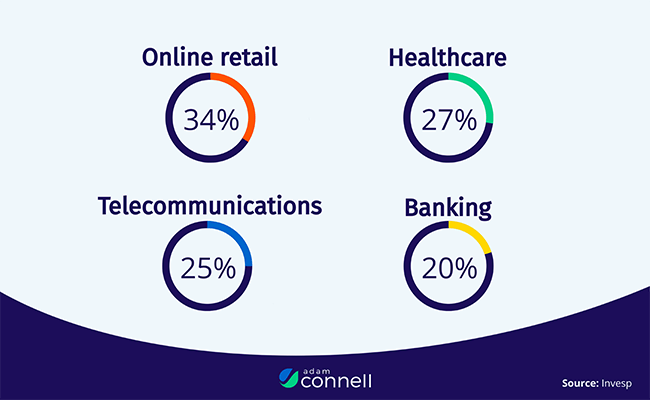
Customers are more likely to accept chatbots in online retail settings than in any other industry. Healthcare has the second-highest acceptance of chatbots by consumers at 27%, and telecommunications is third at 25%. Banking and financial advice have an acceptance rate of just 20%.
Source: Invesp
32. The top use case for chatbots in ecommerce is canceling or tracking an order
This makes sense. It’s a very routine query that is easy for chatbots to answer. Other use cases include requesting refunds, inquiring about specific products, and making purchases, but these are all more complex queries and are less common.
Source: Solvvy
33. For ecommerce stores, chatbots are most effective at generating leads for clothing items
If you’re running an online retail store that sells clothing products, give chatbots a try. They can help you generate more leads and sales.
We’re seeing this kind of approach being adopted by large stores like Amazon. Hiring a real person to answer random questions about clothes just isn’t feasible. But an AI chatbot can handle the job without breaking the bank. It’s this kind of personalized marketing that can take your brand to the next level.
Source: Tidio
Chatbot marketing statistics
Many businesses are utilizing chatbots as part of their marketing strategy. Here are some stats that tell us more about the demand for chatbots in the digital marketing industry.
34. 28% of leading companies use AI for marketing
The most successful brands & agencies use AI to scale personalized marketing, ensuring every automated reply feels relevant to the specific user’s journey
Over a quarter of them use AI in their marketing strategies. If you want to compete with these leading companies, you should be too.
Source: Adobe
35. Around 91% of marketing agencies think chatbots will become an integral part of business operations
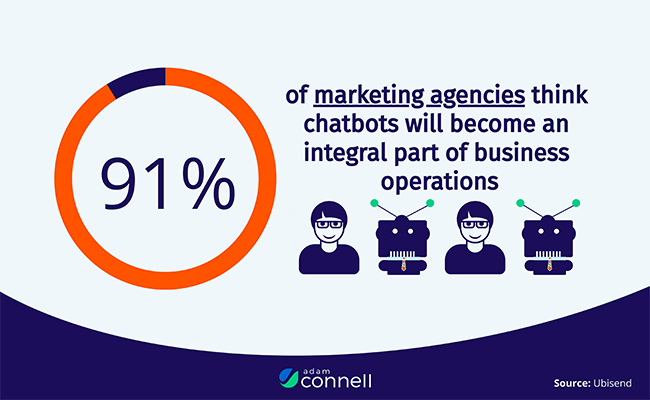
More than nine-tenths of marketing agencies surveyed by Ubisend said they suspect chatbots will become an integral part of their business operations — and they’re probably right! Chatbots have become an essential marketing and sales tool, so for agencies that offer marketing services, leveraging chatbots is a no-brainer!
Source: Ubisend
36. Over 86% of marketing agencies think the brands they work with will expect them to be able to help with chatbots
Marketing agencies are seeing an increasing demand for chatbot marketing services and other AI-related projects. If you’re running your own agency and want to maximize your business opportunities, it’s worth considering adding chatbots to your services.
Source: Ubisend
37. 40% of marketing agencies say their competitors already offer chatbot services
In the survey by Ubisend, almost half of marketing agencies said their competitors already offered chatbot-related services to their clients. If you want to continue to compete, you should be too.
Source: Ubisend
38. Around 73% of marketing agencies have tried out different chatbot platforms for their clients
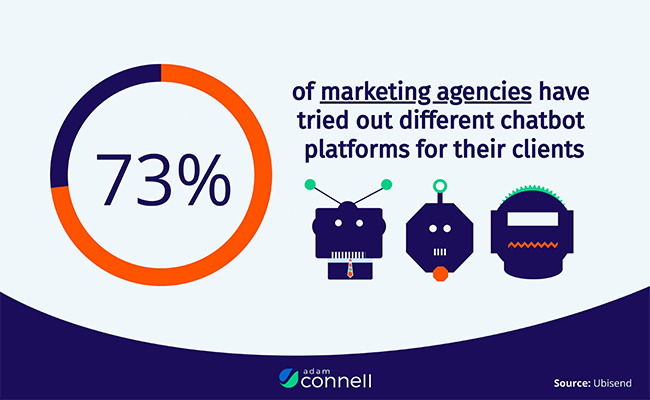
There are lots of different chatbot platforms out there to choose from, and it can be tough to know which to pick. As a result, three-quarters of marketing agencies say they’ve experimented with different options to find out which one performs best for their clients.
Source: Ubisend
39. Over 53% of marketing agencies report new leads looking for chatbot services
Over half of marketing agencies say they’ve experienced new leads that were looking for chatbot services. If you’re a marketer and don’t want to miss out on these potential customers, consider offering chatbots.
Source: Ubisend
40. Over 68% of marketing agencies say some of their clients have shown an interest in chatbots
Aside from new leads looking for chatbots, 68% of marketing agencies also say that their existing clients have shown an interest in the software.
Source: Ubisend
Chatbot challenges statistics
We’ve talked a lot about the benefits of chatbots, but what about their drawbacks? Let’s find out. Here are some stats that highlight some of the main challenges facing the chatbot industry.
41. The biggest perceived disadvantage of chatbots is that they can’t address complex/personalized questions
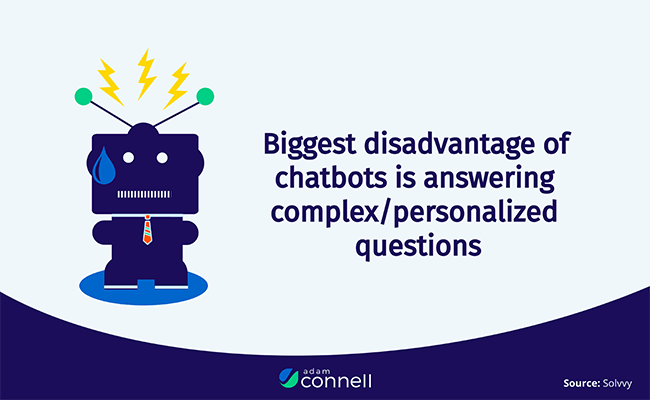
Given how limited early chatbot iterations were, it’s not surprising that so many people feel that their primary disadvantage is that they’re unable to address complex or personalized questions.
However, the truth is that many next-gen chatbots can actually handle these types of questions. There will always be some queries that chatbots struggle with and that a human could deal with better, but as technology continues to advance, the number of queries that fit this description gets less and less.
Soon, it may be the case that chatbots are powerful enough to answer even the most complex queries even more effectively than live agents.
Source: Solvvy
42. 46% of people would rather receive live support, even if a chatbot was quicker
There’s no doubt that consumers are warming up to chatbots. However, there is still a big consumer segment that prefers live support. In fact, almost half of all consumers admit they’d still prefer to speak to a real human even if a chatbot can provide faster support.
To combat this, chatbot developers need to work on improving customer interactions with chatbots. This might mean making them more conversational and approachable or improving their ability to understand complex problems.
Source: Usabilla
43. 50% of companies say they don’t use chatbots because they don’t know how
Interestingly, half of all companies admit they’re reluctant to use chatbots as they don’t understand how to implement them. If you’re someone who feels the same way, don’t let it hold you back.
It’s easier than ever these days to add chatbots to your website these days. You don’t need a team of developers or to be a tech whizz to do it. In many cases, it’s as simple as installing and activating a chatbot plugin on WordPress or adding a snippet of code to your website’s source code.
There are plenty of plug n’ play chatbots out there that you can use right out of the box. Alternatively, you can build your own using a no-code chatbot builder platform like WotNot or Landbot.
I’d expect that this is an issue for bloggers as well. As Chatbots become more accessible, I expect to see bloggers and creators make more use of them. Both across their social media channels and blogs. They could easily be used for affiliate marketing purposes, for example.
Source: Tidio
44. 16% of companies are worried about the time and cost of maintaining chatbots
This is another factor deterring many businesses from using chatbots. If you plan on developing your own chatbot, part of the development process involves regularly updating and testing to improve the bot. You may need to program more responses or update existing responses to reflect changes to your business model or consumer expectations, etc.
All of this takes time and money. However, it’s worth thinking about whether the maintenance costs involved in running a chatbot are offset by the cost savings and leads it brings into your business.
Source: Tidio
45. 65% of people say they’re likely to leave a business due to a negative chatbot experience.
That’s right. Two-thirds of your customers say they’ll walk away if they have a negative experience with your chatbot. This statistic shows that while offering a chatbot can have a positive impact on your business, it can also have a negative impact if you get it wrong.
It also highlights how important it is for companies to raise the bar of what their chatbot can do. Customers tend to get frustrated by chatbot limitations and won’t hesitate to stop using a service or buying a product as a result, so make sure yours is able to answer as many queries and resolve as many issues as possible.
Source: Solvvy
Social media automation: A new frontier for chatbots
While many of the statistics in this guide focus on onsite support, the most significant shift in the industry is happening within social media ecosystems.
Platforms like Facebook, Instagram, and WhatsApp have transitioned from simple messaging apps into full-scale commerce hubs, and chatbots are the engine making that scale possible.
Today, a successful social media marketing strategy is almost impossible to maintain manually. With users expecting responses in under five seconds, brands are increasingly turning to AI-driven automation to handle the top-of-funnel engagement.
Whether it’s qualifying a lead through an Instagram DM or providing personalized product recommendations in Facebook Messenger, chatbots allow you to be present for your audience 24/7.
By integrating these bots into your social strategy, you aren’t just saving time; you’re feeding your lead generation funnel with highly qualified prospects. This automated engagement also helps build the brand signals that Google looks for when evaluating your overall authority, indirectly supporting your SEO and link building efforts.
Frequently asked questions about Chatbots
As AI continues to evolve, the way we use chatbots for marketing is changing. Here are the answers to the most common questions about implementing automation.
Final thoughts: The future of automated engagement
The statistics above make one thing clear: automation is no longer an extra. It is the backbone of a modern digital presence. Whether you are using bots to scale your social media marketing or to manage your customer support, the goal is the same: to be available exactly when your customer needs you.
To get the most out of your automation, don’t let it sit in a silo.
- Integrate your data: Use your content marketing insights to feed your bot the best possible answers.
- Scale your outreach: Combine bots with link building strategies to manage your relationship-building at scale.
- Stay personalized: Always keep the user experience at the center of your automation.
By connecting these tools, you aren’t just saving time; you’re building a smarter brand that can scale faster.
Hand-picked related reading:
