
34 Top SMS Marketing Statistics (2026 Industry Data)

Curious about the latest SMS marketing statistics? I’ve got you covered.
In this post, we’ll be looking at some eye-opening data pulled from the latest studies, surveys, and reports on SMS marketing.
These stats will shed light on the current state of SMS marketing, highlight how consumers feel about marketing text messages, and reveal useful benchmarks you can use to measure your own performance.
Plus, they’ll also highlight the trends shaping the SMS marketing industry, as well as the challenges and hurdles that marketers still have to overcome.
SMS marketing at a glance: Key insights
We’ll get to the full list of statistics in a moment. First, I’ve put together a summary of the insights we can glean from all of this data. Use this data to inform your own marketing strategy and slap up your competitors.
These insights show that SMS isn’t just a standalone tool; it is the most effective way to drive immediate action from your social media marketing and email efforts.
| Metric | The Data | Strategic Insight |
| Open Rates | SMS marketing boasts a 98% open rate. | No other channel comes close to the visibility of a text message. It is the gold standard for time-sensitive content distribution. |
| Response Speed | 90% of SMS messages are read within 3 minutes of receipt. | Speed is the key to conversion. Use SMS to announce “flash” offers or new SEO research to your most engaged audience. |
| CTR Success | SMS click-through rates (CTR) are 6x to 8x higher than email. | If you want to drive sales, SMS is the most reliable channel. |
| Consumer Desire | 91% of consumers are interested in signing up for texts from brands. | Your audience wants direct access. Integrating an SMS opt-in into your marketing strategy is critical. |
| Lead Generation | SMS can increase lead conversion rates by up to 100%. | Direct communication removes the friction found in traditional lead generation funnels. |
| Automation Flow | 60% of marketers say SMS is their top-performing automated channel. | When paired with chatbot automation, SMS becomes a 24/7 sales and support engine. |
| ROI Impact | SMS campaigns often see a 25x+ return on investment. | Because the overhead is low and the engagement is high, it’s one of the most profitable personalization tactics available. |
General SMS marketing statistics
First, we’ll kick things off with some general SMS marketing statistics. These stats tell us more about how many businesses are utilizing SMS in their marketing campaigns, the ways in which they’re using it, and the benefits it offers.
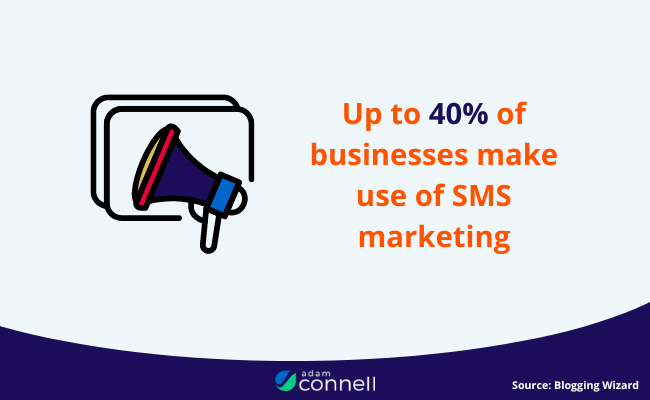
1. Up to 40% of businesses make use of SMS marketing
SMS marketing might have been a niche channel at one point, but that’s no longer the case. Almost 40% of businesses now utilize text messaging as part of their marketing strategy, making it one of the top marketing channels. That’s still much less than email, but it’s catching up.
Source: Blogging Wizard
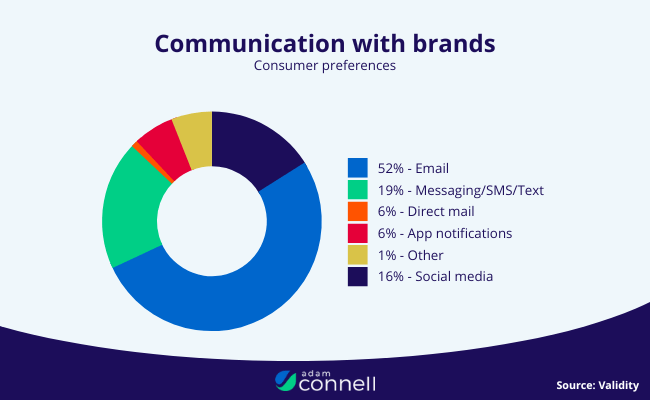
2. 19% of surveyed consumers prefer to communicate with brands over SMS
It’s not brands that are increasingly seeing the benefits of SMS as a marketing channel—it’s also consumers.
According to a recent survey from Validity, almost 20% of consumers around the world selected SMS as their preferred brand communication channel. This puts it second only to email (52%), but above social media (16%), direct mail (6%), and app notifications (6%).
Source: Validity
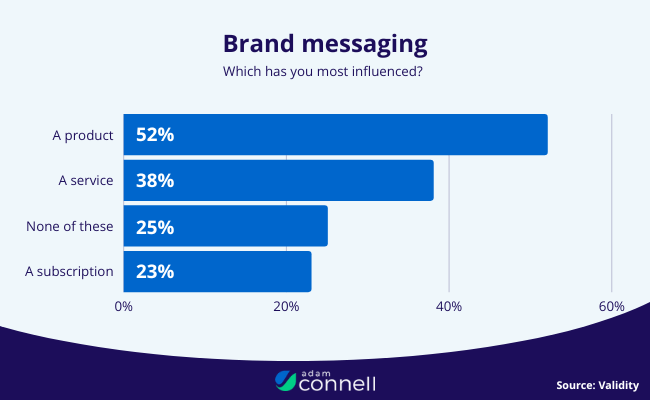
3. 52% of surveyed consumers said they’ve been influenced to buy a product because of a marketing SMS message
That’s right, more than half of the people who receive SMS messages end up buying a product as a result, which shows just how useful SMS marketing can be at driving sales.
In addition to the 52% of respondents that said they were influenced to buy a product, a further 38% said they’d been influenced to purchase a service as a result of an SMS message, and 23% had been influenced to sign up for a paid subscription. Only a quarter said none of the above applied to them.
Source: Validity
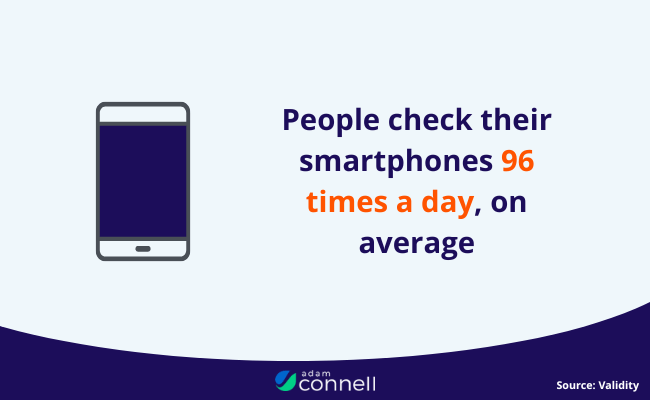
4. People check their smartphones 96 times a day, on average
This stat highlights one of the biggest advantages SMS marketing has over email marketing—it gives you a lot more opportunities to connect with your customers.
Most people only check their emails a handful of times a day, but we’re seemingly never off of our phones. By sending out marketing communications via text rather than email, you’re making it more likely that consumers will see your messages and engage with them.
Source: Validity
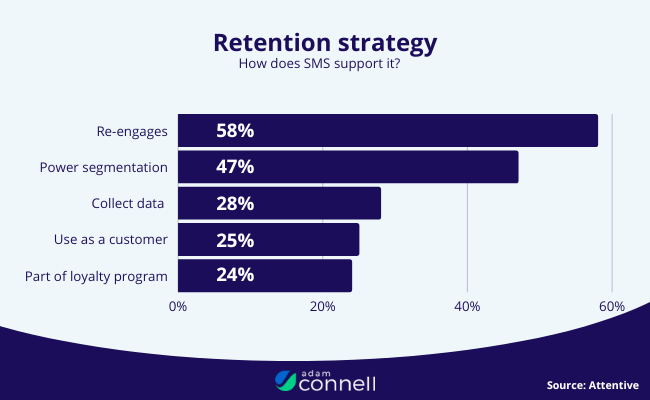
5. 79% of marketers use SMS as a retention channel
Another area where SMS stands out is when it comes to customer retention. Many businesses use SMS as a post-purchase retention channel as it can be great at keeping customers coming back again and again.
In fact, 58% of surveyed marketers said that SMS supports their retention strategy by helping them to re-engage lapsed customers.
Source: Attentive
6. 53% of marketers say SMS is one of their top 3 revenue-driving channels
And 22% of those say they drive over 20% of their revenue from SMS marketing. The upshot? If you’re not utilizing SMS marketing, you could be missing out on sales and revenue.
Source: Attentive
7. 25% of marketers use SMS as a customer service channel
SMS isn’t just good for delivering marketing messages. It’s also a great channel for providing customer service.
For example, you can use SMS to send out feedback surveys to your customers asking them to evaluate their experience with your brand, which helps to show you care and keeps your customers happy. Simple post-purchase thank you messages also go a long way.
You can also use it as a communication channel for problem resolution. Instead of resolving tickets over email, making phone calls, or answering queries over live chat, you can have your customer support agents connect with your customers directly over SMS.
Source: Attentive
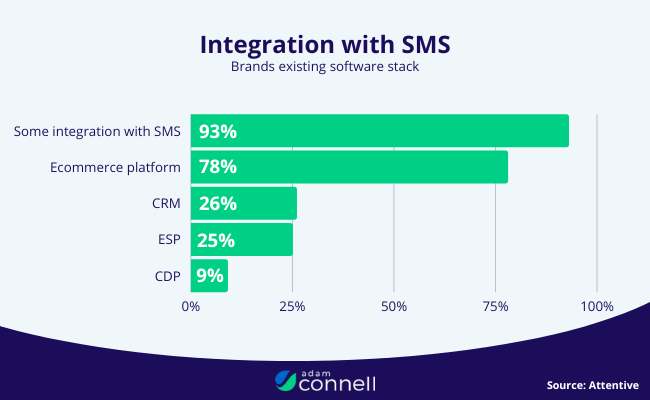
8. 93% of surveyed brands have some integration with SMS
The vast majority of brands have already integrated SMS with their existing software stack
Integration with ecommerce software is the most common form of SMS integration. 78% of marketers say they’ve hooked up their SMS program to their ecommerce solution.
26% had also integrated SMS with their CRM (customer relationship management) platform, 25% with their ESP (email service provider), and 9% with their CDP (customer data platform).
Source: Attentive
SMS marketing benchmarks
Next, let’s take a look at some useful SMS marketing benchmarks. You can measure your own SMS marketing campaign performance against these benchmarks to figure out whether you’re performing on par with other companies in your industry.
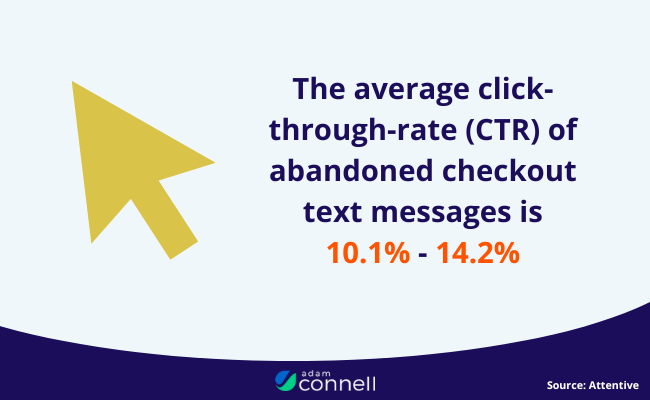
9. The average click-through-rate (CTR) of abandoned checkout text messages is 10.1%-14.2%
Abandoned checkout messages are simple reminders that invite customers to come back and complete their purchase after they leave your site mid-way through the checkout process.
Amongst restaurant businesses that send out these abandoned checkout messages via SMS, the average CTR is 10.1%-14.2%. This is a good benchmark to aim for and evaluate your own performance against.
It’s worth noting, though, that this average doesn’t apply to other types of SMS messages—average CTR varies substantially based on the message type.
For example, welcome messages can have an average CTR anywhere from 5% – 30.4%, back-in-stock messages have average CTRs of 10.9% – 13.2% and post-purchase messages have average CTRs of 4.9% – 8.8%.
Source: Attentive
10. Cart abandon messages have an average conversion rate (CVR) of 24.6% – 39.4%
Cart abandon messages are like abandoned checkout messages, but they’re sent out to customers who leave the site with items in their cart, as opposed to those who leave during the checkout process.
Interestingly, cart abandoned messages have the highest CVR of any message type at 24.6%-39.4%. This shows just how effective they can be—over a quarter of those who receive and click them are likely to convert, on average.
Other top-performing message types when it comes to CVR include post-purchase texts (14.6%-33.3%), abandoned checkout texts (17.4% – 31.6%), and welcome messages (14.4% – 27.2%).
Source: Attentive
11. Abandoned checkout messages have the highest RPM (revenue per message) at $3.46 – $10.05
While abandoned cart messages demonstrate the highest conversion rates, abandoned checkout SMS messages drive the highest revenues per message.
You can expect to earn between $3.46 and $10.05 per abandoned checkout message if you’re performing at or above the industry average. Considering it hardly costs anything to send abandoned checkout messages out, implementing them should be a no-brainer.
Again, it’s worth noting that average RPM varies greatly by message type. Abandoned checkout messages have by far the highest average RPM, while campaign messages have the lowest at just $0.16 to $0.37.
Source: Attentive
12. Average SMS opt-out rate is somewhere between 0% and 1.5%
Again, this is a useful benchmark to keep in mind when deciding on KPIs for your SMS marketing campaigns. If more than 1.5% of the people who receive your SMS messages are opting-out, on average, there’s likely a problem you need to address.
0% – 1.5% is the average opt-out across message types, but again, there’s a lot of variation within that. Welcome messages have the highest average opt-out rate range (up to 1.5%), while campaign messages have the lowest (0.3% – 0.6%).
Source: Attentive
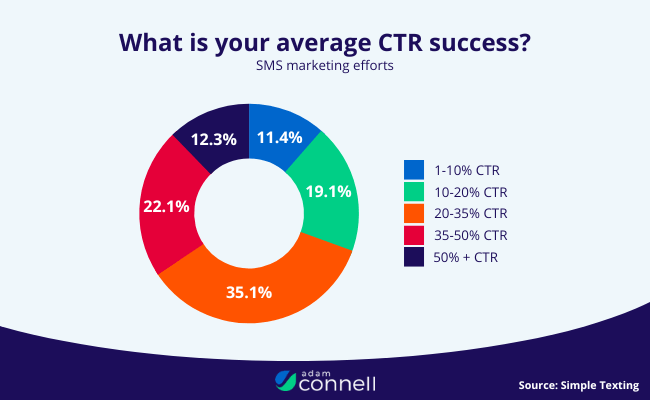
13. On average, SMS marketing has a higher CTR than email marketing
Most businesses see a much better CTR (click-through rate) on their SMS communications compared to email. The most common SMS CTR is between 20 – 35%, while the most common email CTR is between 1 and 10%.
This likely has a lot to do with the frequency with which consumers check their smartphones. As we’ve seen, people check their mobile phones dozens of times every day, but they only check email a handful of times.
Source: Simple Texting
SMS marketing engagement statistics
The SMS marketing statistics below offer insight into the ways that consumers engage with text message communications from brands.
14. The average consumer has 192x more unread emails than texts
When it comes to engagement, marketers often compare SMS engagement rates to email marketing engagement rates. According to Ecommerce Bonsai, SMS messages have a much better open rate than emails, and people have nearly 200x more unread emails than they do text messages.
Source: Ecommerce Bonsai
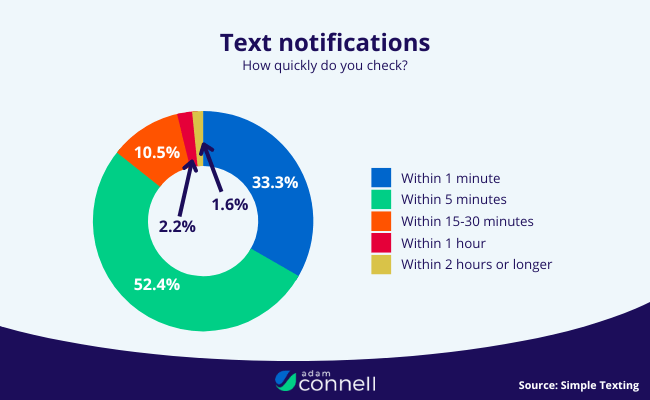
15. ⅓ of consumers will check a text within one minute of receiving it
According to Simple Texting, 1 in 3 people will check their texts within one minute of receiving them. For SMS marketers, this is great news, as people are much more likely to see SMS communications from businesses when they are checking their texts this frequently.
Source: Simple Texting
16. 51% of consumers will reply to a text within 2 minutes of receiving it
Not only do a good chunk of consumers check their text messages very quickly, but they also reply very quickly. In fact, over half of all consumers text back within just 2 minutes. In comparison, it typically takes consumers a few hours to reply by email.
Source: Simple Texting
17. 70% of consumers will opt-in to receive texts from businesses, on average
Interestingly, SMS marketing also has a very high opt-in rate. Although you may expect less people to be open to receiving marketing texts, it actually has a high opt-in rate of 70%.
Source: Simple Texting
18. 43% of consumers have contacted a business via text
Again, this stat shows just how willing consumers are to engage with brands over text. Almost half have contacted businesses over SMS, and 81% have received a text from a business.
Source: Emarketer
SMS marketing best practices
These statistics highlight some interesting consumer preferences when it comes to SMS marketing, and offer some ideas for best practices that brands and marketers should stick to.
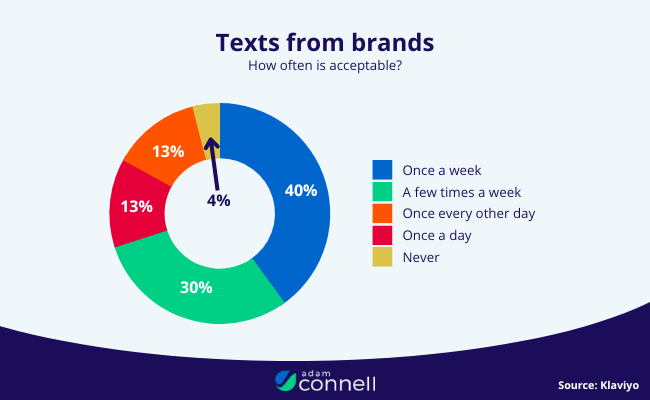
19. 40% of people believe businesses should only text them once a week
How often businesses send text messages is vital to the success of SMS marketing campaigns. According to a Klaviyo consumer survey, 40% of people feel that 1 text message per week from businesses is enough.
30% of people said they were open to receiving texts a few times a week, so between 1 and 3 messages a week is probably the right amount for businesses to aim for.
Source: Klaviyo
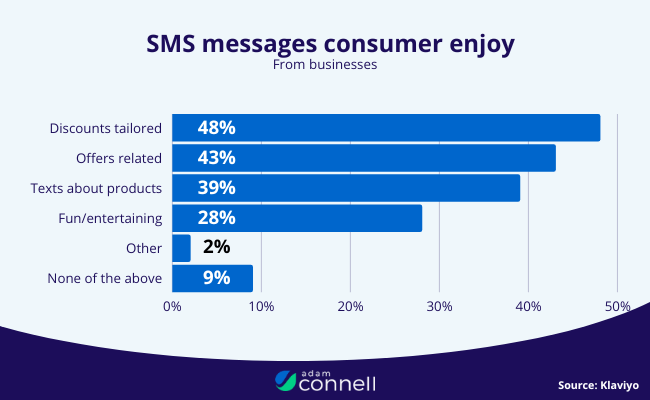
20. 48% of consumers enjoy receiving tailored discounts via text
When it comes to what messages to send to customers, there is a clear favorite amongst consumers. Almost half of the survey respondents told Klaviyo that they enjoy receiving tailored discounts via text message.
Other texts people enjoyed receiving included offers related to interest, personalized text, and fun, entertaining, and helpful texts.
Source: Klaviyo
21. Almost half of consumers said they would like to receive ‘item in cart’ reminders less often
44% of consumers told Klaviyo they would like to receive items left in cart text messages less often.
However, the most common text that consumers would like to receive less often was ‘interesting and helpful articles’.
Looking at the data, it seems as though consumers are more partial to receiving offers and order information by text than they are to receiving general information and announcements.
Source: Klaviyo
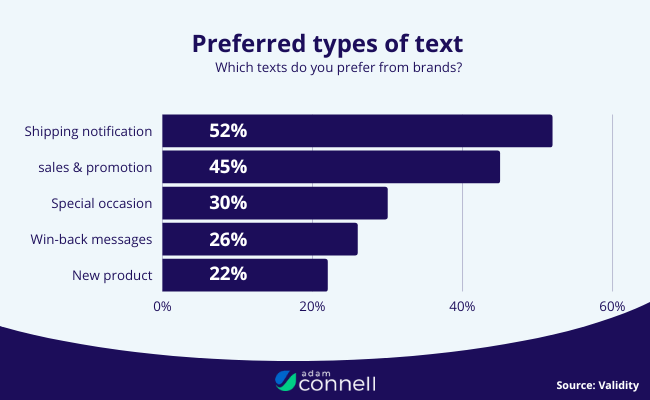
22. 52% of customers say shipping notifications are the type of text they most like to receive from brands
Overall, more customers said that they preferred receiving shipping notifications by text than any other type of communication. 52% of customers told Validity that this was their preferred type of SMS marketing.
This is likely because shipping details are often time-sensitive, and customers may find it easier to follow and track order updates via text than email.
45% of consumers also told Validity that their preferred SMS type was sales and promotional texts.
Source: Validity
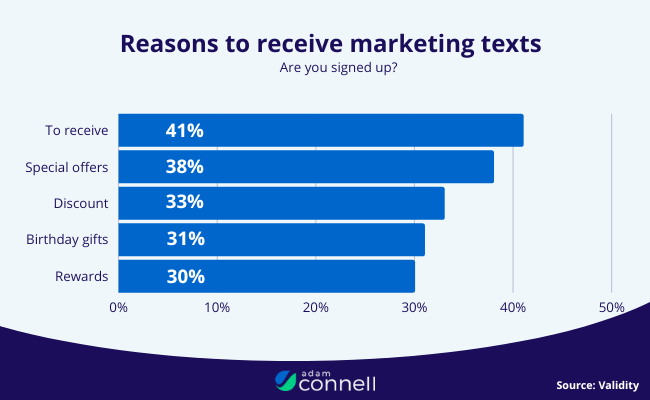
23. 41% of consumers have opted-in to receive SMS messages specifically to receive shipping notifications
In fact, the main reason that people opt-in to a brand’s SMS marketing list is in order to receive shipping notifications.
41% of people said this was the reason they opted in, whereas 38% said that it was because of special offers and promotions.
As shipping notifications are the main reason people opt-in to SMS communications, offering shipping details by text seems to be a good way for businesses to build their SMS contact list.
Source: Validity
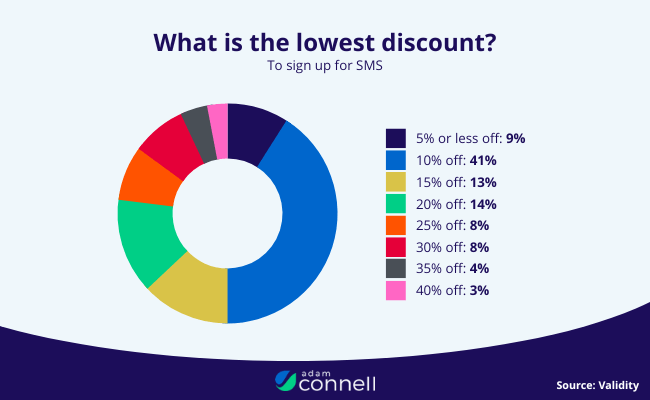
24. 41% of consumers say the minimum discount they’d need to be offered to sign up for SMS is 10% off
If you’re considering using a discount incentive to build your SMS contact list, then it’s important to offer the right amount of discount to encourage sign-ups.
Almost half of surveyed consumers told Validity that the discount would need to be at least 10% for them to sign up.
Comparatively, only 9% said they would be willing to sign up for SMS communications if the discount offered was 5%.
Source: Validity
SMS marketing trends
Here are some interesting statistics that reveal the trends shaping SMS marketing, and how it might change in the near future.
25. 20% of Gen-Z consumers are open to the idea of text-to-buy functions
One of the biggest trends in the SMS marketing industry is text-to-buy. This allows consumers to make purchases via text or SMS message. Although this practice is in its infancy, it’s quite popular among younger generations.
According to Simple Texting, ⅕ of Gen-Zs would be happy to make a purchase using an SMS message with text-to-buy functionality.
Source: Simple Texting
26. Over 60% of people would like the ability to text companies back
Currently, most businesses use SMS marketing to send 1-way messages to consumers such as offers, promotions, and order updates.
However, as chat-based support increases in popularity, it’s likely that 2-way texting between customers and brands will become commonplace.
In fact, consumers are keen to have this option, and over 60% of consumers told Simple Texting that they would like to be able to communicate and respond to companies by text.
Source: Simple Texting
27. The number of businesses using SMS marketing increased by 27% year-over-year
SMS marketing is not just evolving, it’s also increasing in popularity and usage overall. According to Simple Texting, the number of businesses using SMS marketing has increased by 27% YoY.
Source: Simple Texting
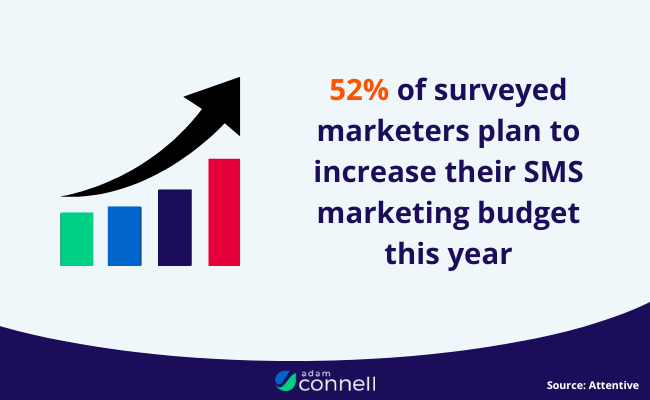
28. 52% of surveyed marketers plan to increase their SMS marketing budget this year
And not only are more companies choosing to use SMS marketing, but they’re also spending more overall on this marketing channel. Over half of marketers plan to increase their SMS budget this year according to an attentive survey.
This is greater than any other paid marketing channel. In comparison, 45% expect to increase their social media budget and 38% expect to increase their email budget.
Source: Attentive
SMS marketing challenges
Finally, let’s take a look at some stats that highlight the challenges that brands/marketers still face when it comes to SMS marketing.
29. 96% of surveyed consumers say they’ve felt annoyed by an SMS marketing message occasionally
SMS marketing has many benefits, but most people find it annoying at least some of the time. 96% of consumers told Validity that they occasionally find SMS marketing messages annoying.
This is something for businesses to think about when planning their campaigns, as it’s important to find a good balance so as to not annoy consumers too much with constant communication.
Source: Validity
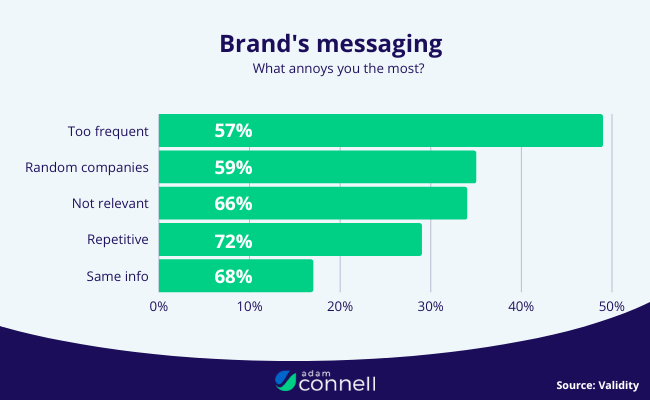
30. 49% of consumers say they’re most likely to get annoyed when brands message them too frequently
The main reason that consumers get annoyed with SMS communication is that businesses message them too frequently.
Other top reasons include receiving messages from companies they haven’t interacted with (35%) and receiving messages that aren’t relevant to them (34%).
29% also find duplicate/repetitive messages annoying, and 17% dislike getting messages with information that they already know. Timing is also a challenge and 17% of people dislike getting messages at inappropriate times.
Source: Validity
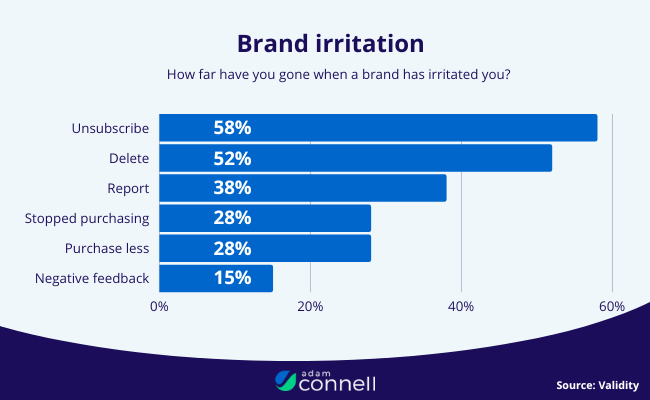
31. 58% of consumers have unsubscribed after getting annoyed with a brand’s messages
As a result of annoying texts from brands, consumers are also likely to take some sort of action.
58% of consumers told validity they unsubscribed because they find brand text messages annoying.
In addition to this, 52% deleted messages without reading them, 38% reported them as spam or junk, and 28% stopped doing business with the company altogether.
28% also said that they purchased less due to text messages and 14% left a negative review as a result of receiving text communication.
For these reasons having a sms marketing strategy is seen as high risk, however, comes with a high reward.
Source: Validity
32. 84% of surveyed consumers have received SMS marketing messages from companies they don’t recall signing up for
One of the biggest challenges companies face when it comes to SMS marketing is the general reputation of the marketing practice. A big proportion of customers have received SMS messages from companies they don’t recall opting in for.
This could be due to forgetfulness in some cases, but unfortunately, it’s due to some companies buying and selling customer data and engaging in dubious marketing practices.
This threatens the validity of SMS marketing and is something for businesses to consider when deploying their SMS campaigns.
Source: Validity
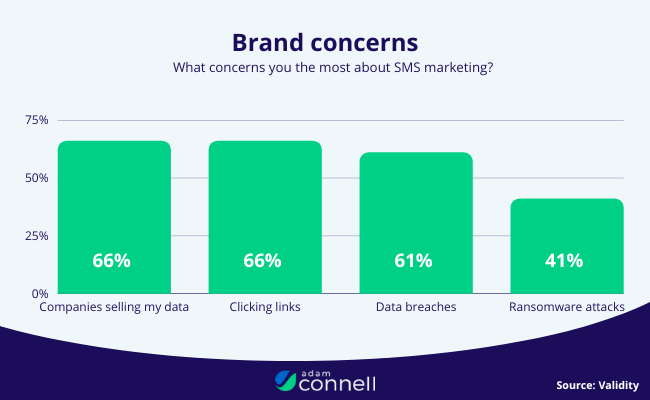
33. 66% of consumers say they’re concerned about the companies that send them SMS messages selling their data
Although SMS marketing can have huge benefits for businesses and consumers alike, consumers are still worried about data privacy, as well as other security risks.
66% said they are concerned about their data being sold, and the same amount also said they’re worried about text-based scams.
Just over 60% claimed they worried about data breaches, and a further 41% claimed they were concerned about ransomware attacks.
For businesses considering using SMS marketing, data security should be a priority in order to ensure consumer peace of mind.
Source: Validity
Social media to SMS: building a direct-to-consumer bridge
While social media platforms are incredible for reaching new audiences, you are always at the mercy of their algorithms.
Today, the most successful social media marketing strategies focus on moving rented audiences from social feeds into owned channels like SMS and email.
By using your social profiles to promote exclusive, text-only updates, you create a direct line of communication that bypasses the noise of a crowded feed. This direct access allows you to push your latest content marketing assets and lead generation offers directly to your users’ pockets.
This surge of high-intent traffic doesn’t just drive sales; it also provides the user behavior signals that help your SEO efforts by showing Google that your site is a destination people actually want to visit.
Remember: Google uses browsing data from Chrome in their rankings. This matters.
Frequently asked questions on SMS marketing
Is SMS marketing right for every business? Here are the answers to the most common questions about using text messaging to grow your brand.
Final thoughts: straight to your customer’s pocket
The statistics in this guide prove that SMS is the most powerful attention tool in a marketer’s arsenal.
To remain competitive, you have to meet your customers where they already are: on their phones.
By bridging your social media strategy with the direct response power of SMS, you’re building a marketing engine that doesn’t just reach people. It moves them.
The first step is moving people from rented social media platforms to owned channels such as SMS and email.
When putting together your mobile messaging strategy, don’t forget WhatsApp. Read my post on WhatsApp statistics and trends to learn more.
